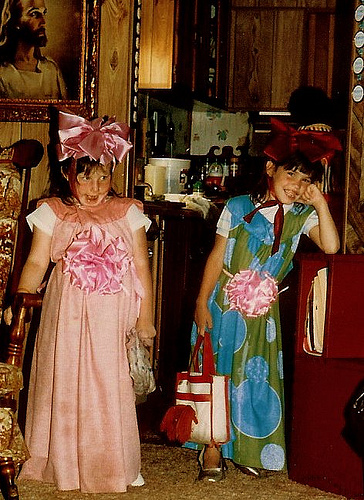
• Where’s the ghost of Dorothy Parker when you need her? It seems silly that I feel compelled to cover this as a PSA, but apparently there are people out there who really do need to be schooled in how to trash talk with élan. And being on the receiving end of their ill-timed, poorly-phrased or overly loud spewing forth is rather an awkward situation to find yourself in (Dear Abby and Emily Post would surely agree).

    So, for when all the WTF? eyebrows raises in the world don’t seem to get the OMG, you need to not do this right here right now point across and forcefully clamping your hand over their mouth in a bid to shut them up is a little too intimate a gesture, you can simply slip the neophyte badmouther in your life this handy list.

    3680516424_6a27d1b70fPhoto by Tebbek

    How to Trash Talk Like A Pro

    • Choose your venting partner wisely. Start out with generic kvetching to see how they react (knowing nodding vs. scandalized side eye). Pull back if they seem uninterested or aghast. If they start agreeing vocally or interject their own bitchy asides, you’ve got the green light.
    • Maintain trash talking parity in the interests of mutual implication. Don’t hog the conversation. If you’re both venting your spleens, there’s a lower likelihood of the other party ratting out your uncharitable rant at some future juncture.
    • As a corollary to the above, keep the trash talking focused on how a given situation or person affects you vs. running through an itemized list of the failings, flaws and general douchery of your boss, ex-girlfriend or brother-in-law. Tread lightly where social slander is concerned.
    • Nothing in writing ever. Not in email, on Facebook, Twitter, IM, etc. This should really go without saying.
    • Unless you’re talking about famous people or those at least three states removed, skip actual names.
    • Use your indoor voice. Actually, use your trying not to wake Mom and Dad up as you sneak downstairs on Christmas morning voice. The walls, sidewalks and adjacent restaurant tables have ears. This is the same reason you should choose your venue with care.
    • Guilt is your enemy. Own the vitriol.
  • I spent a good fifteen minutes clicking around TV Tropes yesterday in an effort to find a list of shows that have employed the device of having the rest of the cast freeze while one character addresses the audience. I could swear there are shows other than Saved By the Bell that have used this trick, but maybe I’m getting it confused with general breaking of the fourth wall.

    3604528042_9c8650d472Photo by espresso marco

    In any case, I was thinking about how damn useful such an ability would be in the real world. Because, as it stands, there’s precious little breathing room to go around for most of us these days. There’s the frying pan and the fire and it isn’t a even a hop, skip and a jump between the two. One job, relationship, decision to the next.  Do not pass Go. Do not collect $200. Taking a timeout to assess the landscape, figure out where you are and where you want to go is a luxury most of us have decided we don’t have room for. Sure, pulling over to the side of the road to read the map might be helpful, but it would also cost us precious seconds out of the unspecified break-neck journey we’ve apparently all decided we’re on.

    It’s not that we aren’t constantly preoccupied with analyzing our lives, because, as a generation, that’s more or less our thing,  it’s just that we can’t seem to gain any emotional or intellectual distance in order to view our past choices and future options with something approaching objectivity (or really, most of us would just settle for evaluating them through a slightly less panicked lens). It’s the equivalent of planning battle strategy while you’re actually in the foxhole – It might prevent you from getting your head shot off in the short-term, but it’s really no way to win a war.

    So, what’s behind our inability to catch our breath? Maybe it’s a function of our inflated sense of self-importance/preservation, i.e., if we take a breather, everything will fall apart. We’re needed, we’re valued, our contribution counts. Things would grind to a halt if we weren’t giving our 110% 24/7. And the pay-off?  Well, who can put a price tag on such validation?

    Or maybe it’s the fear of finding out exactly the opposite. That things will continue on without us. There are more where we came from and if we slow down, get distracted, take our eyes off the prize, there’s someone right there to take our place and capitalize on our past efforts. If we hit the pause button, we’re the only ones who will be frozen, the rest of the world will rush on by and we’ll be left behind.

    So, we keep pinballing through our days. We tell ourselves that we’ll get around to thinking about the big picture and really figuring everything out later – after this killer deadline, in a couple of months when things calm down, as soon as I’m debt-free, definitely before I hit the big 3-0, give it a year or two, still plenty of time to worry about settling down and starting a family, there’s at least another three decades until retirement.

    Guess what, folks? The magical time that you’re waiting for is never coming. There will never be a “right” time to freeze the action, clear your head and/or take (baby) steps to be happier. There will never be a point of having “made it” to a great enough degree that you will then feel sufficiently secure to give yourself permission to finally address all of the other things you let slide (i.e., friendships, relationships, travel, learning for pleasure, etc.) while you were making it. There’s the now and the never, with only the futile hopes that are the someday or the eventually or the soon between them.

    And I’m sure I don’t have to tell you that there’s no real-life rewind button either.

  • When I recognize that I’ve been having variations on the same conversation with multiple people, it’s usually a good indicator that the subject matter might be something worth writing about. This week, it’s been the emotional aspect of growing up. I discussed the material nature last week and the disconnect a lot of  Gen Yers seem to experience between the traditional benchmarks of adulthood and how they expected these maturity markers to make them feel, but we didn’t really delve into the intellectual or emotional side. I’m not a fan of the child/adult, youth/age dichotomies and don’t happen to personally subscribe to the notion that being a grown-up is some sort of fixed state that one reaches or inhabits. I prefer the idea that as we accumulate experiences and exposure to the world, we continually refine our sense of self and our sense of the world/others. It’s not so much a process of growing up (although, for the sake of simplicity, I will use that phrase), as it is one of growing increasingly nuanced in both what we think/feel and how we interpret these thoughts and feelings. I am, therefore, loath to offer a checklist for what I believe constitutes being an emotional adult. And really, who am I to say? Rather, I’d like to shine a light on several* general shifts in thinking that I believe tend to go hand in hand with the process of refining and redefining ourselves. Think of them as symptoms of increasing maturity if you will. And don’t worry, the prognosis is pretty good, even if we’re all terminal cases in the end.
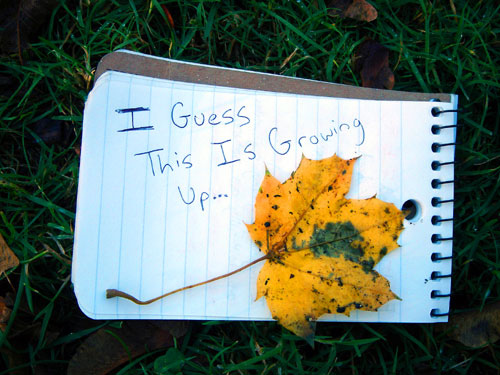
    233119530_239fc8efb3Photo by cognitive.evolution

    Expecting less of ourselves and more of others

    Sounds selfish, doesn’t it? In fact, it’s merely an inverting of the way many of us have spent years thinking – pressuring ourselves to live up to expectations of achievement, behavior, appearance and disparaging and doubting ourselves for failing to meet them, while at the same time giving others latitude we’d never grant ourselves. Growing up involves examining this power dynamic and the way we’ve allowed it to control us. It involves realizing that we’re our own worst enemies (and forgiving ourselves for being so very merciless for so long) and figuring out that, 90% of the time, falling short of so-called expectations goes unnoticed by anyone but us. People are too busy living in their own heads to spare more than a cursory thought (if that) for our foibles. Examining the power dynamic also means questioning the sway we’ve given others over our happiness and the importance we’ve placed on external approval and acceptance, the treatment and inequity we’ve accepted in the pursuit of love, friendship and the desire to be validated as worthy by someone whose opinion we’ve prized over our own. Growing up involves reclaiming that power in the name of giving ourselves a break, painstakingly building and guarding a sense of self that we can wholeheartedly stand behind in the face of disapproval, conquering the fear that we aren’t enough to warrant acceptance on our own merits and learning that we don’t have to capitulate or compromise as compensation for being less than we’ve convinced ourselves we ought to be. And it involves discovering and defining our terms and using them as the guide by which we invite people into our lives and manage our relationships with them. A tall order, but that’s what the ever increasing average life expectancy is for.


    Prioritizing being understood over simply being liked

    Isn’t being liked enough? Surely, we shouldn’t look a gift horse in the mouth? If we’ve been lucky enough to find someone (or multiple someones) who enjoy our company, appreciate our personalities and genuinely care for us, what more is there to it? Well, there’s being understood. As we grow older and we realize that acceptance isn’t the holy grail we made it out to be, we also come to figure out that being liked isn’t an anomaly, that believe it or not, we have qualities and attributes that attract others and that if we’re pleasant, considerate and accepting people (or simply not egregiously repellent), being liked on a social level shouldn’t come as a surprise. We come to realize that most folks aren’t that particularly discriminating and that passing muster as an okay individual is much easier than it seemed in our angstier younger minds. But this epiphany is a double-edged sword. Being liked suddenly isn’t enough. We long for something deeper and more meaningful. We want to be understood. We want others to get us, what we’re about at the core. We want them to want to strip away the humor, the charm, the empathy or whatever it is that drew them to us initially and to feel compelled to find out what’s under there. And we want them to be able to put the pieces of what they find together and to still stick around after they’ve solved the puzzle. And year by year, we get a little wearier of hashing through our backstory and waiting for someone to nod knowingly and jump in to say it’s okay to skip straight to the last page.

    Losing our tolerance for uncertainty

    Whether it’s the fact that we simply become overwhelmed by limitless choices/possibilities/potential futures and want to seek refuge in a smaller evoked set of options or we start to worry about amassing resources to buttress us against our own mortality, as the years stack up, we start to see the future in narrower terms. When we’re younger, the idea that anything can happen is more exciting than frightening, but somewhere along the way, the scales tip in favor of the fear and we start to see an ambiguous future as a cause for dread rather than optimism. We replace rock star daydreams with anxiety over ticking biological clocks and dead-end jobs. Is it because we feel we have more to lose (materially, emotionally and temporally) by embracing the unknown? Maybe we’re simply rationalizing the choices we’ve made and the paths we’ve ended up on and find it too painful to contemplate the way it might have been. The older we get, the more it seems as if we cling to sunk costs and use them to justify not altering our future course of action.

    Realizing that being happy and/or “successful” isn’t a zero sum game

    Some of us never manage to (fully) conquer the green-eyed monster, but others of us, if we’re lucky, eventually begin to realize that there is more than enough contentment and joy to go around, even if we’re not currently experiencing it. It may feel as if it’s rationed, but it isn’t. The universe isn’t robbing Peter to pay Paul and no one is unjustly hogging the happiness that’s meant for you. Put another way, others’ good fortune isn’t at our expense and is in no way indicative of our own prospects  for the same.  Just because your brother lands a sweet promotion doesn’t meant you’ll be stuck working for minimum wage for the next 30 years to keep some sort of cosmic balance. The sooner we realize this, the closer we get to being able to feel and express genuine, unreserved happiness for the accomplishments of others and to  freeing up the energy we’ve been wasting on stomach-clenching envy and self-doubt for more productive purposes.

    *There are obviously plenty of other realizations that could be mentioned, but I think a few of those (for example, the unless you’re pulling them out of a burning building, you have to accept that you can never actually save someone epiphany), deserve their own separate discussion.

  • Suffering under the deadline to end all deadlines (and I mean that most literally). Today’s post will be later than usual. Like, tonight late. Or even tomorrow late. But I will make up for it in awesomeness and a frank discussion of feelings, ‘kay?

    Please feel free to fill the time catching up on my latest  Warp and Weft commentary.

  • 5415_146739345268_523590268_3905548_1194264_n

    I noticed the above poster the last time I was in Boston. I took a picture of it because it seemed so anachronistic.  Ethnic intermarriage and therapy jokes?  Didn’t that type of neurosis-driven humor die out after Woody Allen’s career peaked?  Therapy and multicultural families have gone mainstream.  Actually, in the case of therapy, it has gone  right through being a portrayed in pop culture as a de rigueur standing engagement on par with dropping off dry cleaning  and back around to being considered a specialized service for those in true (however, we define true) need.  I could get sidetracked with a whole discussion of the replacement of talk therapy with anti-depressants doled out by GPs, but A) I have no personal experience with the subject and B) it’s not particularly germane to today’s point.

    And returning to that, I thought of Steve Solomon and his one-man show last week when a coworker and I were discussing career coaches. I remarked that the idea of a “career coach,” just like the “life coaching” profession I spoofed  in this post, didn’t exist 15 or 20 years ago. Its birth and evolution ties in nicely with the  lack of institutional respect among  Gen Yers that I mused about a few week ago. If we aren’t putting our faith in authority figures (clergy, teachers, political leaders) who, if anyone, are we looking to for guidance on how to figure out careers/relationships/being productive members of society? Our (approaching retirement age) parents whose notions of personal and work  success (hands up everyone who’s had the suggestion of law school thrust upon them as a career panacea) is possibly far removed from ours?  Peers who are just as clueless as we are?  And surely we’re too old to take a cue from celebs? Who are we left with?  Enter the personal svengali for hire.

    Our desire for someone to tell us where to stand and when to smile coupled with our disillusionment with traditional role models and voices of wisdom has created an opening for a new crop of gurus, coaches and talking heads to spring up. And they’re only too happy to take our cash while teaching us about visualizing success and identifying our mental barriers to abundance. It’s a seductive proposition. Therapy for those of us who feel our problems aren’t significant enough (and those of us still repressing them. Mustn’t forget those folks.) to merit an MD,  mixed with a little bit of tough love sports mentoring, a dose of new age spirituality and topped off with the unconditional (we are paying for it, so it damn well better be unconditional) support we may not be getting from other relationships in our lives. Is it bourgeois self-indulgence (working three part-time jobs to keep a roof over your head leaves precious little time for pricey navel gazing) or is it filling/identifying a legitimate market need born of the quarter-life crisis mentality and Gen Y’s doubts about the long-term currency of the notion of career satisfaction? Or heck, even having a career in the first place.

    I’m tempted to take a stab at answering these questions,  if only because  one of my dear readers cheekily suggested that I do a little undercover expose on the life coaching phenomenon as my next edifying endeavor.  Is getting down and dirty with Maslow’s Hierarchy of Needs and/or subjecting various facets of my life to a Likert scale a worthy follow-up to adventures in popping and locking? Hmm…

    So, if  you happen to be a life/career coach and A) don’t object to me writing about the process of being coached and B) pinky-swear not to rob me blind or suggest auditing via e-meter, perhaps we should talk?

    And if you’re Steve Solomon; sorry, dude. I’m sure you’re a very funny guy.

  • Someone recently jogged my memory that I hadn’t updated y’all on Project Dance lately. I’d hate for anyone to think that I don’t practice what I preach and had abandoned the effort. Nope, I’m still toughing it out on a weekly basis to comical results.

    I ended up going with the lyrical hip hop class after all and we’ve just started our second routine (retiring Knock You Down in favor of Timbaland’s The Way I Are*). It involves floor work. So Flashdance it hurts. No, it actually hurts, f’reals. I keep bouncing my hip off the floor instead of floating down gracefully.

    2336155038_543820997fPhoto by dydcheung

    The instructor and I have also come to some sort of unspoken understanding, wherein I give it my all and she focuses on critiquing the form of the legitimate dancers in the room instead of tut-tutting over my sub-standard moves. This is likely a sanity-saving measure on her part. You can’t exactly tell someone to hear the beat better or develop an innate sense of musicality between now and next Wednesday. It also means I can relax and just enjoy myself without worrying about judgment.

    Which is a good thing, because, while there’s been some modest progress ( I understand the logic behind isolations if not the execution) since last we spoke, I haven’t exactly improved by (literal) leaps and bounds. I habitually trail my classmates by a move or two and while their body waves look appropriately music video hot, mine is all I’m a Little Teapot up in the house (seriously, you try moving your ribcage in a circle while keeping your hips completely still). Also, the part in the warm-up where we’re supposed to do these graceful, controlled little kicks? I’m still roundhousing like Chuck Norris. I mean, if you’re gonna kick, you should really kick, right? And I’m having an ethical dilemma about the chest pop. Thrusting my chest out like that is pretty presumptuous. What if you don’t want my boobs all in your face like that? And what if they’d sort of rather hang back and play it cool themselves? You can see why I’m conflicted. Well, you can’t literally see. Trust me, it’s better (and less salacious) that way.

    Classes end on Dec 9, so I have a few weeks to figure out what my next edifying endeavor will be. Any suggestions? Although the more I ponder the notion of starting my own post-modern matchmaking service, the more I realize what a truly brilliant idea I may have stumbled across…

    * This video confuses me. What is with the guys juggling soccer balls in the sewer? And I think Timbaland might be holding out, because even though he claims not to be solvent, dude and his posse seem to be rocking some pretty expensive threads.

  • List Served is a semi-regular feature wherein I present you with an ordered grouping of (at least tangentially) related points. I love lists and the internet loves ephemeral minutiae. It’s all good.

    I’m quite sure my approach to personal development and motivation would have much more in common with Tyler Durden than Anthony Robbins, but in the event I ever decide to “monetize” my soapboxing, here are the pearls of wisdom I would be most likely to impart. The lack of a money-back guarantee goes without saying.

    3948369923_93c3419fe9Photo by Temari 09

    JMH’s Top Ten “Life Coach” Lessons

    • Advanced Techniques in Eye-rolling
    • 101 Things To Do Other Than Punch Someone in the Throat, Which is Pretty Much What You Want to Do in the First Place
    • Interpersonal Relationships: An Intro to the Cost/Benefit Analysis Model
    • How to Win Friends and Influence People Via the Crafting of Pithy and Incisive Emails
    • Act Now, Navel Gaze Later: A Short Course in Carpeing the Diem
    • Useless Guilt: It’s Giving You Wrinkles and an Ulcer. I Bet You Didn’t Know That, Did You?
    • The 12 Tenets of the You Are Not… Philosophy: An Intensive Seminar
    • D is for Douchebag and Other Lessons Sesame Street Never Taught You
    • Yes, Fail is a Four-letter Word, But it’s One of the Good Ones, I Promise
    • How to Wield Your Awesomeness as a Weapon of Mass Destruction
  • I stumbled across an interesting little discussion at one of my internet haunts the other day and it set my brain whirring. What started out innocently enough as someone asking if others still felt like adolescents and were weirded out by their peers having acquired all of the trappings of adulthood quickly devolved into some sort of Peter Pan pissing contest with each subsequent discussant attempting to disavow the taint of grown-up status to an ever greater degree. And who says Gen Y isn't competitive? Folks were fairly tripping over each other to assert that their outward signs of adulthood were merely a sham:

    Well, I'm married (we're both engineers) and we're expecting our first baby, but I still feel like a kid! I mean, we might be in the process of building our dream home, but we both have tattoos and I still love going to punk shows and sometimes I eat peanut butter straight out of the jar and watch Yo Gabba Gabba! while my wife is at spinning class.

    A break: I would like you to give it to me. I exaggerate, but only slightly and only to avoid singling anyone out. Yes, I preach the gospel of you are not your job/bank balance/material possessions, but this discussion was less about rejecting these goalposts and more about arguing that they failed to deliver on their implicit promises of adulthood. I have all the grown-up stuff, so why don't I feel like one yet? Not to mention a healthy dose of herd mentality and the desire to blend in with the group by claiming that you too are just one of the mid-twenties malaise crowd. Congrats and welcome to the quarter-life crisis club!  Secret handshake pending.

    1557492245_2f8e9afee9Photo by Ginny Alloway Baker

    There are two factors at work here. Firstly, we've put the cart before the horse by assuming that the status symbols of adulthood would actually confer maturity on us instead of seeing the acquisition of these symbols as simply a tangible means of asserting the maturity we already feel. Having a baby doesn't make you a grown-up, wherein deliberately deciding to start a family is a grown-up (in most cases) decision. See the difference? A mortgage is not a talisman, y'all.

    And secondly, we've conflated being an adult with stagnancy, mom jeans n' dockers and a wisdom we don't feel we possess. We're waiting for our cars, houses and newborns to deliver adulthood unto us, but our notion of said adulthood is skewed. So when buying our first home doesn't lead to a burning desire to read the Wall Street Journal over a morning bowl of bran flakes, we think that there's something “wrong” with us and that we obviously missed the boat to grown-up land. But modern maturity (no, not that one) doesn't look the same for us as it did for our parents or our grandparents. The world is a different place. We grew up and came of age under different political, social and economic circumstances. Our adulthood will never feel the same as theirs did. And expecting it to do so sells ourselves short. We feel as if we're stuck in a perpetual adolescent twilight, so we comfort ourselves by fetishizing youthfulness, while at the same time dismissing the very things our parents and grandparents considered the aspirational proof in the pudding. Well, if we don't feel like grown-ups that's a good thing, because being a grown-up sucks and who wants to be one anyway? So there!

    While this attitude (reactionary and dare I say, childish as it might be)  provides some measure of comfort (especially if you can find a critical mass of individuals who share and reinforce it), there's a very real downside. As long as we regard The Adult as the other, we never really feel entitled to or responsible for making the decisions and choices we associate with adulthood. It both lets us off the hook when it comes to sacking up and making the necessary tough career/relationship/financial calls and infantilizes us and discounts our capacity to actually make these calls in the first place. It's a one-two punch of ambivalence and insecurity and we're socking it to ourselves. And yet, in true Gen Y entrepreneurial fashion, we've also cannily managed to romanticize the heck out of this angst in the form of quarter-life crisis cool at the same time.

    So, pass the peanut butter, I guess?

  • Dear JMH,

    I’ve been reading GenMeh for a while and I get the idea  that you might be a good one to ask about this. I feel like everyone in the world is on a mission to annoy me all the time. Coworkers, friends, family, even random strangers.  I know that everyone has their quirks, but how can I stop taking stuff so personally? Is it normal to want to trip someone for taking too long to go through a revolving door?  Okay, that sounds bad… Maybe I need anger management therapy or something.

    Help? Please?

    -Permanently pissed off

    I’d like to assume that you’re asking me because even though the Dalai Lama and I possess equal measures of zen tranquility, he charges $500/hour for the same advice I’d give you for free. Or maybe it’s because I’ve admitted to keeping a running tally of character traits that set me off? Believe it or not, I’m actually not openly rude, mean or hostile. In fact, I’ve been called sweet. On more than one occasion. I can even furnish written proof if anyone has doubts.

    Moving on. Regardless of my pissy pedigree, what you really came here for was practical guidance on how not to fly off the handle or silently stew over the slights that come your way. To that end:

    2698743188_5bc3f2a767Photo by Fabio Trifoni

    How To Manage A Short Fuse: A Sanity-Saving Guide

    Own it. Some people are sensitive to cold, some are sensitive to loud noises and some are sensitive to what they perceive as interpersonal irritations. C’est la vie. So unless you’re acting on this peevishness and actually following through with the tripping, let go of the guilt. Everyone, no matter how saintly, harbors uncharitable thoughts from time to time. It’s when you let those thoughts lead you to lashing out at/hurting others or when you mentally fixate on them and let them eat at you and/or interfere with your overall happiness and well-being that there’s the potential for problems. Otherwise, fantasizing about repeatedly braining your downstairs neighbor (the one who practices his bass at 11:30 PM) with a Nerf bat is completely normal.

    Realize that some things won’t change. Those are typically the things that have nothing to do with you. Julie three cubicles over has a laugh like a spray of bullets from an AK-47. She will always have a laugh like a spray of bullets from an AK-47. It isn’t a pleasant sound, but she can’t help it and she doesn’t laugh that way simply to get under your skin. Catalogue your most frequent grievances and figure out which of them are just you taking other people’s idiosyncrasies too personally. You’re going to have to let those ones go. They aren’t directed at you and continuing to get bent out of shape over them will only fuel a persecution complex.

    Recognize your part in the annoyance and work to eliminate it. Perhaps it sets your teeth on edge when your friends come to you for advice and then blithely disregard the wise counsel you’ve so thoughtfully provided. Perhaps they’ve been doing this for years and you keep indulging their requests. They are not going to change now, so you need to. If it bothers you to make the effort and have your words fall on deaf ears, stop making the effort. Sure, you will feel like a jerk for a while (you already feel like one, so no change there), but it will be short-term pain for the long-term gain of not having to play amateur shrink/walking encyclopedia/Oracle of Delphi for folks who aren’t really appreciative.  Do not keep stoking your own irritation (sounds dirty, I know) by actively participating in avoidable scenarios in which you already know the outcome and how much said outcome will set your internal rage-o-meter skyrocketing.

  • Last fall, I got into the habit of getting off the bus a few stops early and walking a couple of miles home at the end of the day. I would sling my messenger bag over my shoulder, turn up the volume on Matt Nathanson’s Some Mad Hope on my mp3 player (well over a year of heavy rotation later and I  still love Heartbreak World , Wedding Dress et al. like the first listen) and stride briskly through the autumn chill. Eventually, it got too cold and I went back to my regular routine. But yesterday, I had to return a few books to the library and didn’t have time to take care of the errand on my lunch hour, so I once again hopped off the bus a few stops early and took the long way (better for kicking through piles of leaves on the sidewalk) to the branch closest to my apartment. I even dug out my mp3 player for that authentic old times’ sake feeling.

    On the way back home, I passed a park. The park had a playground. The playground had a swing set. You can see where this is going. I have a six year-old’s love of swing sets (and merry-go-rounds) and while I can usually restrain myself (for propriety if nothing else), the park was completely deserted and the dark was moving in quickly. Now or never.

    1068551634_6b73052a3aPhoto by Steven Erdmanczyk

    I threw my bag on a rock and promised myself I’d just sit for a couple of minutes, maybe glide back and forth a little. That didn’t last. Soon enough, I was swinging in earnest, kicking my feet to try to snag the branches in front of me, tipping my head back to stare up at the  sky and then closing my eyes to just feel the wind rush past and think of nothing at all and everything all at once.

    I thought about what happens to manic pixie dream girls after the credits roll.

    I thought about whether I should start conditioning my hair.

    I thought about how life is incremental. We like to attribute growth and progress and change to the big ticket events, the discrete bursts of endings and beginnings that stick out most in our mind, but we’re off base. You don’t suddenly gain 10 lbs or start losing your hair or wake up to realize that you’re no longer in love with your significant other. No, the movements  happen so slowly that you hardly even notice the shift, until one day, the accumulated changes become too much to ignore and you’re hit in the face with what seem like out-of-the-blue realizations – your pants don’t fit and you’re waking up beside a virtual stranger. And oh yeah, you’re going bald, too. We’re so busy watching, waiting and holding our breath for our own personal sweeps month that we forget about the meaningful minutiae and ignore the avalanche that pelts us one rock at a time.

    And finally,  I thought with a mixture of genuine wistfulness and pragmatism about how I could really use someone to watch my bag and give me a push (meta poignancy?), but that I’ll likely always be too chicken for underducks.