• List Served is a semi-regular feature wherein I present you with an ordered grouping of (at least tangentially) related points. I love lists and the internet loves ephemeral minutiae. It’s all good.

    Photo by Rakka

    • A gift bag containing three giant Lush bath bombs that were meant as a present for someone whose birthday party I didn’t end up attending.
    • The business card from this story.  No sentimentality involved,  I just never clean out the bottom of my purse.
    • Two bottles of ibuprofen, neither of which were anywhere to be found last week when I had a splitting headache.
    • The box for every single box-bound item that I have bought in the last three and a half years. Never know when you’re going to have to repackage your $9 can opener.
    • An drawer filled entirely with safety pins.
    • Approximately 431 scraps of paper with phone numbers, dates and random words scrawled on them, all without context, of course. Apparently, Oct 17, 2008 was a red-letter day. Somewhere. For someone.
    • Three non-working laptops, two of which I had forgotten I even had in my possession and one of which weighs approximately as much as an early model VCR.
    • A 2006 calendar featuring 12 months of dachshunds.
    • The sunglasses my sister  shamed me out of ever wearing again after she disgustedly informed me that they looked like ones our uncle would sport out on the golf course. Point taken.
    • A pair of silver-green child-sized Crocs, of which I have no memory of purchasing or being gifted with.
    • Four Susan B. silver dollars. These made me smile.
    • My MA degree certificate. In a box of scarves and mittens.
  • The other night I was listening to a webcast from the excellent Amanda Palmer (I predict that her star is on the mainstream rise after the whole naked on the red carpet at the Golden Globes thing) while catching up on some email. At one point in the show, she was responding to Twitter questions from her fans. One of the questions involved advice Palmer might have for aspiring artists. Her words caught my attention and I decided that they would make excellent post fodder.
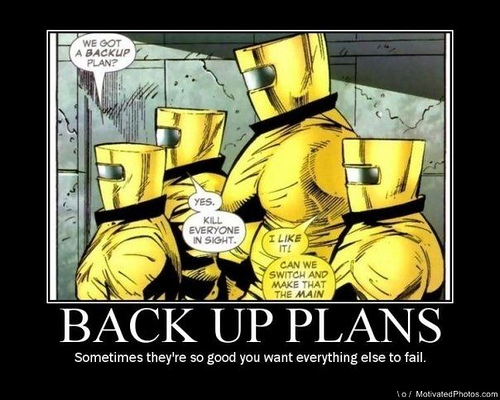
    Photo by Art La Flamme

    In a nutshell, Palmer said not to bother with a Plan B. Convince yourself that what you aspire to will come to pass and give yourself no choice but to succeed. No fallback position, no back-up. In other words, put all your eggs in one basket and guard said basket with your life. Be desperately ambitious and wildly confident and convey that to others, that’s what will make them want to hear you out, to help you. Be ambivalent and everyone can sense it like blood in the water.

    Her sentiments ring true, especially for those on high-risk career paths – artists, writers, performers, entrepreneurs, etc. They have an uphill battle to be successful (and I’m conservatively defining success as making a viable living from their craft/business, not being the next J.K. Rowling or Donald Trump) and in fields such as theirs, hunger and perseverance are more important than raw talent. Gotta be a grinder. Arrive earlier, stay later. Outhustle every other hustler. In these cases, having a back-up plan (different from a gotta keep from starving in the here-and-now gig) encourages complacency*. If you know that you can always go back to being a lab tech or a personal trainer, the publish or perish/sing or starve impetus isn’t there. And you’ll end up losing out to the individuals who do have that impetus. They need to succeed; you merely want it. And if doesn’t work out, you know you’ll still be okay. Crisis averted.

    But what about the rest of us? Surely, there’s no harm in back-up plans for those of us who are of a more quotidian stripe? Not so fast. Firstly, I think it’s useful to draw a distinction between back-up plans and contingency plans. The former being a viable (and likely more or less palatable) option in case your first choice tanks. Plan B is the Miss America first runner-up. Should Plan A be unable to fulfill its duties for any reason (sex tape scandal!), Plan B shall step seamlessly into the breach. A contingency plan is more of a response protocol to a given event. If X happens, do Y. Think of an elementary school fire drill. If the gym goes up in flames, proceed in an orderly fashion to the parking lot and line up alphabetically by class and grade.

    Contingency plans can save you in a jam ($20 in your shoe to take a cab home from an obnoxiously loud and overcrowded party), but Plan Bs are meant to ensure that you don’t end up in the jam in the first place. Why invest fully in Plan A and risk capital F failure (heartbreak, bankruptcy, etc.), when you can simply hedge your bets and bank on good ol’ B to save your bacon? Plan B lets us off the hook. We can put in a little less effort, be a little more moderate in our desire, want it, but not too much and definitely not to an unseemly degree. And if we don’t get it, well, we’ll deal.

    Plan B (and C and D, etc.) is born from insecurity. We fear we won’t get what we want the most, that it won’t last, that we don’t deserve it. So we scale back, we downgrade and downplay. If it doesn’t work out, at least we haven’t lost much. But it’s just this mindset that dooms it to not working out in the first place. It’s a self-fulfilling prophecy. We expect less, give less, get less and then praise ourselves for our pragmatism in having a back-up plan to cover just such an outcome, an outcome that we all but conjured into occurring with our 80% effort.

    People have varying tolerance levels for risk. I get that. And while not everyone is all about risking it all on a turn of pitch-and-toss, there’s a difference between having a solid idea of what you’ll do if you throw everything you’ve got at your dreams and still fall short and never committing fully to those dreams in the first place because you’ve got a few options on the backburner that you’ve been keeping an eye on. If you choose the latter option, don’t kid yourself about what you’re choosing and don’t be surprised when you end up needing to put your back-up plan into play.

    I’m sure Amanda Palmer would agree.

    *And you know how I feel about complacency.
  • Today, kids, we’re going to talk about being unemployed. You’ve all heard the conventional wisdom about the need to get dressed every day, not sleep in until noon and to apply to positions as if it were your job (which it kinda is). And while I’m not going to dispute the idea that watching Judge Judy in your pajamas with a wine cooler (or three) in hand is a less than stellar choice, I assume you already know this. And you can assume that I already know that unemployment is an absolutely dire state for many people, especially for those with heavy debt loads, mortgages, mouths to feed, etc. Pith isn’t what these folks need. No, my advice is aimed squarely at those of you who have the relative luxury (and it is, even if it doesn’t feel like one) of being able to go without a job for a month or two and not start panicking about having to live in a refrigerator box under the Brooklyn Bridge. Maybe you received a severance package, maybe you’re getting employment insurance, maybe you have a partner who can shoulder the full load in the interim or maybe you’ve just been very careful about your savings until this point and know that you can squeak by until your next gig. This isn’t advice on how to find said gig, but how to use the time that you have at your disposal in the most constructive (or least anxiety-inducing) manner possible.

    Photo by John McNab

    Get a routine going

    Unstructured days that just blur together will seem like an energy-sapping eternity. Impose some order and focus, even if it feels artificial. Get up and go to bed at a consistent hour. Determine a specific period of the day when you’ll conduct your job search. And when that time is up? Back away from the computer and call it quits until tomorrow. Don’t let job hunting be a 24/7 albatross around your neck. Devote a defined period of time to it, buckle down and ignore all distractions and then shelve it until next time. Get outside once a day (even if it’s a walk around the block). Give yourself an hour or two for email, IMing with friends or catching up on football scores. Etc, etc. The point is to structure/fill your time and cut down on the possibility of staring off into space for hours on end thinking about the worst case scenario (What’s the going black market rate for a kidney these days?) or berating yourself for not having landed a new opportunity within hours of being pink-slipped.

    Start checking items off your bucket list

    Use this time to work on projects that you’ve always wanted to tackle, but have never had the time to address. Unless you win the lottery or retire early, free time is going to be a very precious commodity during your working life (especially if you have a family), so use this block of it to your best advantage. Sure, backpacking across Europe might not be in the financial cards, but what about teaching yourself Photoshop, learning how to make sushi, brushing up on your high school Spanish? In this case, there’s no time like your unoccupied present.

    Take stock and focus on course corrections as necessary

    Maybe you’re totally happy with your particular field and it’s just a matter of looking for a replacement job for your former position. But if you’re questioning your career choices or have realized that you want to make a change, use this time to figure out your options. Research industries or alternate careers of interest to you, think about your most and least favorite aspects of previous jobs, get professional input (look into whether hiring a resume writer would be a worthy investment, for example) as needed, with the goal of figuring out where you want to go and what it would take to get there. Does it require going back to school, moving to another city with more opportunities or simply reframing your resume for a new industry? Do this now when you have little to nothing to lose, because I guarantee that once you’re re-employed, making a big shake-up will once again seem like a risk you don’t think you can afford.

    Do not feel guilty

    You did not lose your job because you’re a bad person* and you shouldn’t treat being unemployed as some deserved punitive state in which you live in self-imposed misery as a means of reprimanding yourself for having the gall to have been downsized. You are not a loser and taking up permanent residence on your couch, refusing to venture out to see friends and family and telling yourself that you’re never going to find meaningful work isn’t productive, helpful or remotely compassionate. You shouldn’t feel guilty for focusing on yourself while you’re unemployed, for taking time to learn new skills, read more books, get out in the fresh air and/or re-evaluate your career path. Self loathing and guilt are terrible motivators and aren’t going to get you back into the labor force any faster. In fact, wallowing in ’em will just make the days seem even longer and more empty.

    *Unless you were fired for harassing your coworkers or embezzling, in which case, you probably are a bad person.

  • If you’re expecting some inspirational platitude about how each painful failure makes you that much more appreciative of eventual happiness, you should know by now to look elsewhere (or perhaps go listen to this while attempting not to cringe?). No, my argument is that heartbreak toughens you up, it strengthens your reflexes for dealing with drama, makes you a lean, mean failure-handling machine. It’s not about being jaded, it’s about using past pain to inform future responses. Never underestimate the value in learning how to take a punch, regroup, and then throw your own haymaker.

    Photo by David Gallagher

    I’m not speaking exclusively about romantic heartbreak, although I’m sure that’s what springs to mind for most folks. But more broadly, I use heartbreak to refer to any scenario in which the universe stomps up and down on your dreams or  when you suffer a significant personal loss or upheaval that just levels you. The blow can come in many forms, but the result is the same – you’re left flat on your back in the (figurative) dirt. And just like every well-meaning friend and self-help sage predicts, eventually you get over the pain in some fashion. And if you’re lucky, the wound heals and your emotional rear view mirror renders the person or event a speck on the horizon. But what you might not realize when you’re on your feet again is that the whole process actually served to increase your ability to handle potential future heartbreak more constructively and  with a steelier resolve. You’ve got firsthand experience with pain and failure and the calluses to prove it. You know what rock bottom feels like and you can make a conscious decision not to hit it again. You’ll recognize all of the signposts along the way and can start looking for detours and exit ramps ASAP. And if you do find yourself laid out in the dust again, you will know that if you’ve gotten back up before that you can damn well do it again. And again. Repeat as necessary.

    Being kicked in the junk by life is, among other things, a learning experience. In order to develop coping skills, you actually have to have coped with something. Fancy that. They can’t be developed in the abstract; they absolutely need to be road tested. And that testing can only be achieved by getting yourself burned, living to tell about it and being smarter the next time around. Lucky you.

  • Last week, someone referred to me as a writer. I like the sound of that. So much more flattering than newly-unemployed former policy wonk/project manager (sounds like the name of an Alanis Morissette album, doesn’t it?). Writer has appeal not only because it links me with something I love to do, but also because it’s one of those neat little labels that both confers identity and gives others a summary of what you’re about (allowing them to call up the characteristics they associate with this title) in a single word.

    Photo by Steve Wampler

    Writer, like doctor, plumber, librarian or prostitute, is a known quantity. The nuances may go undiscussed (Is she a pediatrician or an oncologist? Are we talking Ashley Dupre or Hookers at the Point?), but you can be relatively sure people get the general gist of what these positions entail should you identify yourself or someone else with one of them.

    Considering that most of us are predicted to switch careers no less than 451 times during our working lives, the days of tried and true job identities are becoming a thing of the past for Generation Y. What I am today isn’t what I was yesterday and won’t be what I am tomorrow. You can refer to flexibility and challenge or you can talk about transience and insecurity. How attached should and will we get to our current incarnation when we’re working and living under the knowledge that it likely won’t last beyond the next 3 – 5 years? While there’s a certain frisson of excitement in knowing that the future is unwritten and that our path to retirement isn’t just a straight line to the horizon, the pressure to keep hustling, keep reinventing ourselves, keep contorting, twisting and coming up with new ways to give employers what we think (or have been told) they want is downright exhausting.

    Not that neat labels are without their flaws. While they might provide an enviable shorthand in a professional context, taken at a more broad social descriptor level, they tend to fall short. The problematically binary nature of gender (male/female), sexual (straight/gay) and political (left/right) identity, anyone? But you can’t deny that there’s something elementally comforting in being Joe the lawyer from Wichita. You might also be a million other things, but it’s a starting point, a place to hang your hat. You belong to a universally-recognized category. Your title fits neatly on a nametag during cocktail parties. You can respond to the question of What do you do? in one word and not a rambling paragraph in which you attempt to encapsulate the entirety of your fragmented job description before the other party nods off into their Chardonnay. Forget the 15-second elevator pitch, you can do it in 2.5, you lucky SOB.

    And yes, I’ll be the first to tell you that you’re not your job title, your salary, your corner office or convertible. And I mean every impassioned word of those diatribes. But I will also admit that when it comes to the inherent uncertainty of drifting through one’s twenties, the palpable envy you might feel for those who can sum up their trajectories in a single word is not only understandable, but completely natural. Doesn’t mean you want what they’ve got, just that surety is in short supply and we can’t help but occasionally craving a little more of it for ourselves.

  • Hate To Break It To You is a recurring feature wherein we dispense succinct home truths that everyone could benefit from facing up to, unpleasant as they may be.

    Photo by boskizzi

    I’ve come to realize that being able to indulge in discontent over one’s life circumstances is a privilege, especially for those of in Gen Y. Sounds like a no-brainer of a revelation, but you don’t really think about how good you have it on the navel-gazing front until you’re faced with those who are living life at the elemental level – grinding it out, just getting through their 24/7 while holding the pieces together, no energy left to articulate their angst in eloquent and itemized detail. They do what they have to do because it needs to be done and there’s no one else to do it. The end.

    I’m not trying to guilt trip you with the whole there are starving children in Africa who’d kill for your broccoli, so eat up trope. Telling people not to bemoan their lots in life because there are others who have it worse is on par with telling someone with depression to just buck up or advising an anorexic to just eat a steak. Insensitive and it doesn’t work. You feel what you feel and it is what it is. And I’ve spent months exhorting people to accept that fact and live with it.

    No, what I’m doing is simply encouraging you to realize that having the space to contemplate, to brood, to feel melancholy or adrift is a luxury that not everyone has. And instead of feeling guilty about this fact, commit to using your privilege in the most personally productive manner possible. Examine the full scope of your options and courses of actions and understand that while some of them might involve sacrifice or deprivation, that doesn’t make them less valid. Acknowledge the wealth inherent in even having options in the first place.

  • It’s a bold assertion, but isn’t that what a new decade is for? Forget about vowing to lose 20 lbs, date more, be better about recycling. The only resolution you need is the one that involves getting more congruence in your life.

    2197460955_0c8e7dd4eePhoto by sirwiseowl

    Tackling this resolution is a pretty simple process. In fact, all you need to do is ask yourself the classic Sesame Street question – Which one of these things is not like the other? Sit down and think about who you are as a person. Which (positive) adjectives would you use to describe yourself? Then think about examples from your day-to-day life that reflect these qualities. For example, do you see yourself as an eco-friendly person? If so, how is this evident in your actions and activities? If you end up drawing a blank, that’s a clue that how you see yourself isn’t necessarily aligned with how you’re living when it comes to this particular value. Maybe you see yourself as a financially responsible and detail-oriented person, but have never gotten around to making a budget to track your monthly spending or researching options for retirement savings. Maybe you’d describe yourself as active and energetic, but can’t remember the last time you darkened the doors of the gym. Resolving to be more congruent involves looking at your self-concept and your actual circumstances, recognizing the areas where there’s a disconnect or mismatch between the envisioned and the concrete and deciding to bring these two pieces back into sync.

    There’s no right or wrong way to tackle the inconsistencies you might discover; it’s simply a matter of deciding to take  steps to make your life more reflective of your values. Maybe you’ll decide that your adventurousness should take the form of backpacking through Thailand and you make a goal to save up for the trip by 2011, or maybe you see yourself as a generous person and decide that this means volunteering for a Habitat for Humanity build. Or maybe you’ll discover that it’s your perspective on yourself that needs changing and not necessarily your behavior. Maybe you’ll admit that as much as you want to be a gregarious life-of-the-party type, this role doesn’t really feel comfortable and playing the social butterfly ends up exhausting you. Instead of pushing yourself even harder to be Ms./Mr. Congeniality, you’ll decide that it would be more congruent to embrace your reserved nature, cut yourself some slack on the social front and realign your self-image to reflect how you really feel.

    As a bonus, identifying and addressing your incongruities will go a long way to uncovering the root causes (the better to begin tackling them!) of the nagging dissatisfaction or anxiety that comes from working and living at cross-purposes.

    So forget about 20 lbs in 2010. Focus on getting right with yourself instead. It’s a commitment that you can definitely stick with past February.

  • List Served is a semi-regular feature wherein I present you with an ordered grouping of (at least tangentially) related points. I love lists and the internet loves ephemeral minutiae. It’s all good.

    328543303_ccf5044584Photo by Zellaby

    • Where’s Chickie? Go get Chickie! Chickie is a squeaky rubber chicken (clad in a bizarre gingham bikini) with whom my parents’ younger dog has a tumultuous love/hate relationship.
    • I don’t know what a noun or a verb is. True story.
    • A discussion of the sexual politics of female body hair removal
    • Widespread agreement on the implausibility of Steve Martin as a romantic lead
    • A daily remarking on the resemblance of my sister to Jersey Shore‘s Snooki
    • Re: one Bon Jovi – He puts on a wicked concert. It’s awesome. Funny how mishearing “wicked” as “wig in” changes the entire nature of the following conversation.
    • Jingle Bells on the harmonica. Repeatedly.
    • Douchebag – Regrettably, my mother has picked up this gem from me.
    • Where’s the flicker? wherein flicker = tv remote
    • Who wants to go to Walmart? Yeah, I know.
  • I’m writing this curled up on the couch in the family room of my parents’ house. The wood stove is crackling, I have a dog on either side of me and I’m enjoying a nice cup of tea* with almond milk. What better circumstances under which to talk about the dangers of complacency?

    282551690_628501b7fc[1]Photo by anthonygrimley


    Sometimes, when things have been rough for seemingly forever, when we finally catch a decent break or a respite, the tendency is to hunker down and hold on for dear life. Things sucked, now they suck less, what more is there to say? And sure, if the sum total of your aspirations is a port in the storm (and depending on your life circumstances, that’s a perfectly legitimate goal), there isn’t really much more for me to say. But if you have the privilege of harboring grander dreams, visions, plans and wishes (articulated or just a vague longing for something more), complacency is your enemy. It’s your fork in the road – stay here in relative comfort, stability and routine, or keep pushing on toward what it is that you truly want. I’ll refrain from discussing the imperative of staying keen and hungry lest I stray into Wall Street/Glengarry Glen Ross/lyrics to a Springsteen song territory, but you get the drift.

    There’s no small measure of guilt involved. Shouldn’t you be grateful for what you have, especially if you know what it’s like to have nothing at all? Why can’t you be happy with what you’ve got? Why do you have to be so greedy, so hard to please? But it’s not about greed. It’s not about being disatisifed with $500 million, when what you really want is a cool billion. It isn’t about keeping up with the Joneses and always needing the latest, the greatest, the cutting edgest accoutrements. No, it’s about realizing that while this job lets you pay the bills and keep a roof over your head, you break out in hives at the thought of doing it for the next 30 years. It’s about acknowledging that while your current significant other is a wonderfully caring, understanding, interesting person, he or she isn’t someone you could ever envision yourself yoked to until death do you part. It’s about not sublimating your long-term desires for the sake of short-term stability. I’m not advocating immediate break-ups, resignations or speed-dialing UHaul, but I am recommending that you take five or ten minutes this holiday season to give some thought to what you want (what you really, really want to quote the Spice Girls) and to look at your present circumstances and the decisions you’re currently living out. Are they supporting this idea of your future self? If not, just what are they providing you with – Security? Stability? Acceptance? A timeout from feeling as if your whole life has been spent thanklessly grinding it out?

    Maybe you’ll decide that things are good enough for right now. Maybe you do need this period of intellectual shore leave to recoup and recharge. But while you’re getting your groove back, keep the bigger picture in the back of your mind. Don’t let a temporary hiatus become a permanent one and don’t let a comfortable routine lull you into forgoing your something more. Stay sharp and you’ll eventually be ready (and eager, even) to trade the r&r for more blood, sweat and tears. The Boss would surely tell you the same thing.

    * Which I made in the microwave, despite the fact my parents have an electric kettle and a teapot. Take that haters!

  • I’ve already tackled general stress-busting tips a couple of weeks ago, but as we all know, the holidays are a whole ‘nother ballgame and I’ve decided that they really do require their own set of ground rules. And given that I’ll soon be on a plane to spend this festive season with my own family (who are wonderful folks), there’s no time like the present*.

    So forget all those cloying tips about relaxing in front of the fireplace with cinnamon-flecked hot cider or taking time to walk around the neighborhood admiring the blow-up Santas and blinking lights, my advice is aimed squarely at those of us who don’t live in a Norman Rockwell painting.

    338134064_65c539ce9f

    Photo by Brandon Cirillo


    Be realistic about your expectations. Think about past holidays. Think about the people you’ll be spending time with and your relationships with them and their relationships with each other. Use this information to shape your expectations for this year. Do your father and uncle always get in a drunken shoving match over whose job it is to move all the cars in the driveway so that someone can make a last-minute run to the 7-Eleven for paper towels and more club soda? Think about parking on the street this time, because things are probably going to play out the same way in 2009. Forget that Christmas Carol BS. People rarely change. And expecting your dysfunctional clan to suddenly shape up and become model celebrants might be funny when we’re taking about a Chevy Chase movie, but it’s just a path to frustration and disappointment for the rest of us.

    Pick your battles. While you can manage your own expectations, you can’t control the rose-colored holiday visions dancing through others’ heads, nor can you control their behavior. It’s up to you to decide what requests to indulge (attending midnight Mass with your grandma even though you’ve been an atheist since you were eight) and which antics to ignore (your sister’s boyfriend’s attempt to goad you into an argument about Glen Beck). As a general rule, with spirits and/or tempers running high, the holidays are not the time to get up on your soap box to issue sweeping moral proclamations, initiate heated debate about political hot button issues or call people out on their shortcomings. Fight the temptation to do so (short-term repression is your friend!).  Keep your head down, your nose clean and save the substantive stuff for after Jan 1.

    Ditch the guilt. Yes, we’re all supposed to feel grateful that we’re surrounded by bourgeois abundance that others with less privilege could only dream of, but does feeling guilty on top of feeling stressed and strung out really do any good? No, no it doesn’t. You’re not a bad person for not having holiday spirit, or for feeling smothered by your extended family or irritated by their quirks. You’re not a jerk if you lack joviality. It is what it is. Give yourself permission to feel whatever it is the holidays make you feel. There’s no right or wrong answer. Just be mindful (as you would at any other time of the year) of not throwing cold water on anyone else’s good mood and that’s all you need to ask of yourself.

    *’tis the season for bad puns