• At any given time, I have three or four draft pieces on the go. Some get finished over a day or two, other take longer and sometimes, I’ll shelve an article for weeks until I figure out just the right wording.

    I’d been working on a piece about the ways in which we fight or attempt to evade life, but hadn’t gotten much beyond the first paragraph. Then a friend posted something on Facebook that got my brain working and in the course of typing out an overly long reply to his status, I figured out how I wanted to approach the article.
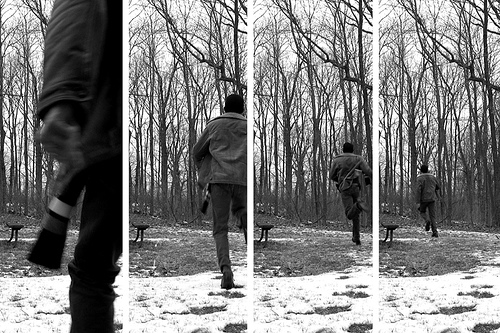
    Photo by roujo

    In the past, I’ve written about the need to take the wheel when it comes to determining your direction in life and not simply sitting back and letting life happen to you. In the immortal words of Dr. Betty Dodson, it’s called “getting on top and running the f*ck.” But there’s a distinction to be made between showing life who’s boss and taking an adversarial approach to it and to yourself. Making deliberate decisions and not ceding control over your future to the whims of fate is one thing,  but actively trying to deny reality or living in fear of being unable to outrun your own nature and and the repercussions of your past decisions is a very different matter. The problem with taking an adversarial stance toward anything (yourself, life in general) is that eventually you’re going to let your guard down or get distracted and it’s going to knock you flat on the floor with a haymaker to the jaw. No matter how many rounds the fight lasts, you can never count your opponent out. And getting back on your feet is that much harder because you’ve only ever thought of  yourself or your circumstances as the enemy and haven’t developed the tools or skills to work with it vs. struggling against it. Antagonism can only take you so far before you need a less exhausting strategy to navigate the world.

    And for a lot of us, that less exhausting strategy seems to hinge on outrunning ourselves. Maybe it’s because spring is in the air, but lately I’ve heard more that a few people (and I count myself among them) waxing poetic about ditching it all and disappearing. Just walk out the door and don’t look back. A cave in Morocco, the next flight to Japan, an emo song about Boston. It all comes from the same place. We’re not just running away from our lives, we’re also longing to run directly into the arms of the Other, the other being the self we imagine that we could be if we could only get a little space from our current versions, enough distance between here and there, if we could only get far enough away, we could finally be who we’ve always thought we had the potential to be, free from the shackles of our flawed, workaday selves. As if unfamiliar surroundings and the very nature of being a stranger in a strange land would allow us to unlock our untapped potential and to reinvent ourselves in the idealized image in our minds without that pesky business of our past interfering. But even if we do ditch it all with only a passport and credit card in hand, the newness of wherever we land will eventually wear off, we will unwittingly develop routines, a familiarity of place and space and we will come to know and be known (and to be known is to be judged, by others and ourselves) and we’ll realize that there was no transfiguration – merely our same selves on another coast, in another country (check out Up in the Air or listen to this gem* if you don’t believe me). And we feel as if we’ve failed, as if we missed the window of opportunity that would have let us emerge from our cocoons as individuals stronger, braver, better than the sad sacks we left behind. This is a fantasy, of course. Short of reincarnation, there is no such thing as alchemy of the self. There is no alternate version of us waiting to be set free in Sao Paolo, Saigon or San Diego.  But the idea that he/she is out there, waiting to be summoned from the bench to pinch hit for our current iteration is a seductive one.

    It comes down to externalizing – externalizing your own nature as something to be struggled with, externalizing life (or LIFE) as a separate entity with designs on bringing you down instead of simply the context in which you exist as created by your cumulative experiences, decisions and social realities (these might be outside of your immediate influence, but that doesn’t mean you should let them define you) and subject to change based on purposefully seeking out new experiences and making different choices in the future.

    No matter how we romanticize it (and I’ve thought about writing a how-to guide to faking your own death, so I know from romanticizing) “fighting” life or “running” from yourself is just another way of abdicating control. If we acknowledge that we’ve created and empowered the very fears we’re trying to escape from and if we’re strong enough to do the hard work, we can deconstruct these emotional and intellectual straw men with our own two hands and not in six months at an ashram in India. Right here, right now.

    *Will never get tired of linking to this vid. NEVER.
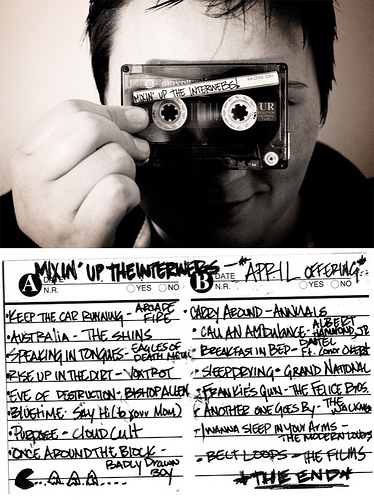
  • Owing to a number of factors (promising a bunch of folks I’d make them one, fighting insomnia by thinking of wacky playlists, this piece from a True/Slant colleague), mix tapes (henceforth referred to as mix cds because we are in the 21st century) have been on my mind lately. The selection and arranging of just the right mix of complementary songs is serious business. Given that I consider myself pretty skilled in this arena, I thought I’d share my top tips for crafting note-perfect mix cds.

    Photo by jk5854

    Themes are your friend

    Unless I want to use the disc as a piece of propaganda to convince someone why they need to drop everything and become a fan of x artist and his entire catalogue right now, I rarely make a cd without a theme. There’s a whole lotta music in the world and choosing to zero in on only a tiny little portion of it means that you aren’t overwhelmed by potential choices. The more specific your theme is, the better. For example, instead of Canadian Artists, why not opt for The Worst Songs Canada Has Ever Foisted Upon the Rest of The World (My Heart Will Go On, Skaterboi, Have You Ever Really Loved a Woman?, etc.). Being very targeted with your theme also provides a nice little challenge when it comes to finding enough songs to fill out the ranks. Goes without saying that I enjoy a good challenge. For example, how about a cd devoted entirely to songs about rain* (Have You Ever Seen The Rain?, Umbrella, Rainy Days and Mondays, etc.) or maybe one focusing on secular songs with religious references* (Personal Jesus, God Only Knows, Like a Prayer, etc.)? Themes also take your taste and that of the potential recipient out of the equation, so there’s no worrying that your friendship will be forever doomed because she doesn’t share your boundless enthusiasm for Bright Eyes (please tell me you’re not boundlessly enthusiastic about Bright Eyes).

    There are always rules

    There are rules for how to choose songs and how the mix cd recipient should listen to the end product. In the first case, I like to make sure to include at least one song from each mainstream musical genre if possible and to only use one song from a given artist. Depending on your theme, there may be a need for additional guidelines. For example, when I make a geography-based mix, I include songs that have the place name in the title or lyrics as well as songs from artists whole hail from the thematic city or state. If, however, an artist from a particular place also has a song about that place, I will include that song even if there are other choices that I find preferable. For example, If I were to make a New York City cd, I’d have to include Billy Joel’s New York State of Mind over something like Only the Good Die Young. Them’s the breaks.

    When it comes to rules for the listener, mine are simple; you must listen to the whole cd all the way through on the first listen (no skipping past songs you don’t like) and you must play all of the songs in order. Threatening to smite people if they don’t comply is wholly optional.

    Be careful with context

    While a solid theme takes a lot of the guesswork out of making a mix, the end result comes down to a judgment call re: what’s appropriate and what’s just downright awkward. If you’re making a horticulture-themed cd for your former college roommate, no matter how well it fits the theme, you might want to omit Bon Jovi’s Bed of Roses once you remember that she and the boyfriend who cheated on her during freshman year considered it to be their song back in the day.

    Currently, I have a Motown-themed cd on my to-mix list and I’ve already run up against a potential issue in the form of Marvin Gaye’s Let’s Get it On. On one hand, it’s a seminal (heh) classic of the genre. On the other, it’s a whole lotta song, a whole lotta suggestive song. Sorta breaks the lighthearted poppy flow of the Temptations, Four Tops et al. and takes things to a weird PG place. In the end, it will probably make the cut because A) it is a classic and B) throwing it in there is really too hilarious to resist.

    * These will probably end up on my to-mix, too. Am also contemplating the idea of a Monarchy Mix (Two Princes, King of Wishful Thinking, Queen of the Night, etc.)

  • Hate To Break It To You is a recurring feature wherein we dispense succinct home truths that everyone could benefit from facing up to, unpleasant as they may be.

    Just because something or someone looks good on paper doesn’t mean it works off the page. CVs, self help books, OkCupid profiles, Facebook status updates; if it’s there in black and white, it must have merit, right? And when this doesn’t prove true, we’re downright stymied. While facts might not lie, they don’t tell the whole story. The job description for your dream position tells you little to nothing about organizational culture, which might be so toxic that you end up fleeing the place in horror six months after your date of hire. The fact that your mutual friends are both only children, both into yoga and die-hard anime fans doesn’t guarantee sparks when you set them up on a blind date. Maybe he’s a closet misogynist or she’s not truly ready to re-enter the dating pool after a bad break-up. And sometimes, it runs in the opposite direction. Match-ups, career moves and life decisions that look like veritable disasters in print turn out to be just what the doctor ordered. They meet needs or provide benefits that we can’t capture in prose or didn’t anticipate when we were making our neat little checklists. And that’s what keeps things interesting, isn’t it?

    Photo by nic’s events

    As we live more of our lives and conduct more of our personal business online, we become increasingly invested in our on-paper selves (and everyone else’s, too). Keeping up with the Joneses, putting our best foot forward, making that all important first impression, etc., etc. When all we have is the paper, it’s difficult to look beyond it. I get that. If all I know of you is what you post on Twitter or Facebook photo albums of your family vacations or what you write in your blog, well, those are the inputs that I’m going to rely on to make a judgment about who you are as a person. You’re certainly more than 140-characters tweets and pictures of your three little angels, but that’s all I have firsthand experience with.

    Acknowledging our limited and imperfect information is the first step to putting on paper in context. Your CV tells potential employers what you’ve done in the past, but it doesn’t define your potential for the future. Your degree indicates that you’ve successfully accumulated a body of knowledge on subject X, but that doesn’t mean you’re tied down to eating, sleeping and breathing only X for the duration of your professional life if you genuinely don’t want to be and are willing to go back to the drawing board. Someone’s chronic inability to spell definitely correctly doesn’t indicate a character flaw requiring permanent shunning (Although, if they’re also prone to throwing around “anyways,” the shun potential does increase, I cannot lie).  You can see where I’m going with this.

    Bottom line? Life on the page and in person doesn’t always sync up. We’re more than our bullet lists of accomplishments, turn offs or GPA. Sometimes, on paper is all we get, but even then we should realize that there are qualities and nuances that it can never capture and accept that any conclusions we draw exclusively from it (both positive and negative) are subject to being proven dead wrong in the flesh.

  • For want of a nail the shoe was lost.
    For want of a shoe the horse was lost.
    For want of a horse the rider was lost.
    For want of a rider the battle was lost.
    For want of a battle the kingdom was lost.
    And all for the want of a horseshoe nail.

    We are different people at different points in our lives and the relationships we form in those periods might not have been forged under other circumstances.  The You you are are today isn’t the You you were during rush week in 2001 or on the first day of work in 2005 or three weeks after a break-up in March of 2009. And I’m not talking about maturing or all of that older and wiser jazz, simply that the way that you treated the world and the way that you let it treat you in these very different circumstances wasn’t the same in each case and isn’t the same as you would do and be done unto today or six months from now.

    Photo by quas

    I’ve been thinking about this idea a lot lately.  I’ve been thinking about the stories and explanations we create for ourselves in order to assign a meaning other than random chance, dumb luck, a flat tire. Stories we spin that make it seem as if things were meant to be (or weren’t), that provide the logic, the reason and the narrative we need to make sense of exactly where we’re standing right now instead of chalking it up to the intersection of circumstances and capricious or deliberate choices we made in the moment. Where’s the cinematic drama in that?

    If she hadn’t stopped by your cube to borrow your stapler and you hadn’t been eager to make a good impression on your new coworkers instead of  simply smiling and returning to your papers as you’d do once the newness of the job wore off,  then you wouldn’t have struck up that  conversation about American Idol and discovered that you both suffered from mortification by proxy for all of those hopeless contestants and your enduring friendship wouldn’t have been cemented over the fact that you both knew all the words to Free Love Freeway from The Office and can’t even think about Ricky Gervais trying to dance without wanting to throw up.

    Or if you had been angry at the world that day because you spilled red wine on your favorite tie and weren’t  in the mood to socialize or she had been suffering from a killer head cold and had opted to skip the party to stay home and rewatch Love, Actually for the 12th time, you wouldn’t be sitting across from each other at Starbucks bickering over whether to cap the wedding guest list at 100 or 150 right now. But you call each other The One and you never stop to think about how terribly convenient it is that your One happens to live in the same city of 300 000 people and happened to be attending that same Christmas shindig as a favor to your former college roommate. I mean, really, the world contains six billion people, how nice for the universe not to give you a soulmate who is currently harvesting rice in Cambodia and with whom you couldn’t even communicate in a common language. Don’t ever say the cosmos never did anything for you, kiddo.

    I kid, but the underlying point is valid. We’re variable just as much as the circumstances are and who we are and how we are in the world at a particular period in our lives shapes the content of our lives in that period and the nature of our interactions with others. We’re braver, more reticent, open to adventure, fed up with humanity and its BS, lonely, brimming with confidence, etc., etc. And while we’re cycling through our ups, downs, in and outs,  stuff is happening around us all the time. All the time. People and opportunities and tangents and possibilities for hilarity, heartbreak and world domination are marching past us or bubbling below the surface and what’s going on in our heads and our lives dictates whether we notice  and if so, what we notice and what we do about it. Thinking about this is rather mind-boggling, isn’t it? The point isn’t to overwhelm you with the pressure to capitalize on the thousand tiny micro chances that fill every day, but to encourage you to acknowledge that what seems right right now might not have seemed right six months ago or might not seem right two years from now and to cut yourself some slack for having waited so long to finally go back to school or start doing the legwork to launch your own business even if these plans had been in the back of your mind forever*. We make our choices and take our actions in context and we need to keep this in mind when reading the tea leaves of our own pasts. Sometimes (more often than we feel comfortable admitting), it really does come down to timing – ours and the rest of the world’s.

    * Not to say that I don’t advocate the carpe diem approach, but I also advocate the no sense crying over spilled milk one as well.

  • Hate To Break It To You is a recurring feature wherein we dispense succinct home truths that everyone could benefit from facing up to, unpleasant as they may be.

    “Karma is not currency. You can’t pay your rent with unicorns and goodwill.”

    -Moi, in conversation with a friend

    Wanting to do positive, meaningful work and wanting to get paid a wage that adequately compensates you for your time and skills are not mutually exclusive. I see this attitude a lot, especially in the not-for-profit sector, or among people with a well-developed (over-developed?) social conscience and among organizations that are only too willing to capitalize on idealism as a means of keeping staff costs low. There’s the idea that being concerned with your pay check is at odds with wanting to do good in the world. Not true. Not wanting to work for a pittance doesn’t make you craven or lessen your commitment to a given cause, it simply means that you have respect for the experience, skills and aptitudes that you have invested considerable time and money to build up and that you expect others to demonstrate respect for them by assigning them a reasonable value.

    Photo by bluemoose

    Sure, there are times when you’ll work for less than what you’re worth – when you’re just starting out in your career, when an opportunity comes along that is too good to pass up for other reasons (exposure, advancement, a foot in the door in your dream field, etc.), when you have another source of income to supplement your pseudo pro bono efforts or when the need to pay your bills ASAP takes precedence over everything. But these are (ideally) temporary situations and shouldn’t form the basis of your work philosophy. There are also times when, based on your chosen career, you’ll earn less than is comfortable due to a scarcity of work or clients (i.e., actors, musicians, working artists), but I suspect most of these folks realize all too well that giving it away for free or at less than the cost of the materials it took to knit that sweater or the gas it took to get to the gig is a foolhardy approach.

    Like it or not, cold hard cash is the method by which we assign and reward value in our society. It would be just peachy if we paid everyone in high-fives and root beer floats, but that’s not the way of the world and refusing to acknowledge this reality isn’t taking a principled stand as much as it reads as a display of vulnerability in the eyes of those who hold the purse strings. You’re demonstrating that A) you don’t know how to properly evaluate and price your skill set (a sign of naivete or inexperience) or B) that you can be had for cheap by appealing to your moral conscience. In either case, the other party has an advantage over you and you’ve just willingly committed to an unequal exchange of your services for their compensation. While this may not bother you at the time and, heck, it may not even bother you years down the road, keep in mind that in terms of $, you really are worth more. Realizing this and wanting to capitalize on it (even as you figure out how to save the world) doesn’t make you a bad person or a greedy sell-out.

    And you can take that to the bank.

  • Today, we’re putting a new twist on old-school self help. Have you noticed that we don’t often ask ourselves questions, at least not of the exploratory variety. Sure, there’s the rhetorical What am I going to do now? OMG, where are my keys? Why can’t I ever finish a carton of soy milk before it goes bad? etc., but not the kind of queries that we actually sit down to devote time to answering. Questions that when taken seriously might help us get a better look at where our head is, what makes us tick and what factors are contributing to our current state of mind.

    Photo by Sebastian Niedlich

    So, just for fun (and possibly enlightenment purposes) I want to delve into a few of those questions today. Instead of writing them out and then asking you to ask them to yourself, which is both a little awkward and kinda smurfy, I thought it would be easier to imagine me asking them and you responding as you see fit (you trust me, right?). You can think over your answers silently, share them out loud with your cat or write them down on paper. And just for the record, to make this as authentic as possible, I’m sitting here in a tweed jacket with fake leather patches on the sleeves and I have a pipe. But not a real pipe, one of those bubble pipes that kids have. The kind where you blow into them and bubbles come out of the bowl?  I just have to be careful not to inhale or I’ll end up with a mouthful of soap.

    Now to the questions. Ready?

    When are you happy? Please note the format of the question – I’m not asking what makes you happy. To which you could answer unicorns, single malt scotch or hitting all the green lights on your commute. No, I want you to describe the situations and contexts in which you experience happiness in your daily life.  What are you doing? Are there other people with you?  What are they doing? Once you have your list, I want you to see if you find any common themes –  maybe all of the activities you describe revolve around creating things and sharing them with others? Or maybe they all feature various modes of problem solving? Try to identify if there’s a pattern to the happy.

    What are the biggest roadblocks in your life right now? These can relate to any facet of your life – career, family, relationships, etc. Try to describe or analyze  how they’re holding you back. For example,  let’s say your answer  is money. You have $75 000 in student loan debt, your job barely covers your bills and you’re worried about long-term job security. Maybe this financial ambiguity is keeping you from pursuing new opportunities,  you feel tied to your job (even if it isn’t the right fit for you) because it’s  a source of stability and you feel as if your debt burden is preventing you from exploring possibilities that might be a better fit because they would require an additional investment of resources –  going back to school, starting your own business, etc. When you get right down to it, your roadblock is a lack of autonomy to make and implement decisions because of what you see as the constraints of your financial situation. Once you get beyond the one word answer to this question, you can see that because you’re able to define your roadblocks more broadly, you can start considering the fact they can be attacked via more than one approach. It’s no longer simply a linear relationship between lack of money and lack of choice; there are means of increasing your feeling of control over your life that are non-monetary in nature and that will give you some sort of sense of autonomy in the interim between now and digging yourself out of debt.

    If you weren’t faced with any constraints, expectations or obligations, what would you be doing for the rest of your life? If you didn’t have worries about paying bills, living up to your “potential,” or making anyone proud, how would you spend your days?  I like this question, because everyone’s first inclination is to talk about traveling the world or spending their days on a beach,  but when you start really turning this over in your mind, most people still have this hardwired desire to contribute to society, to create and share some sort of value, but the nature of what that value is is often both much more altruistic and more reflective of their own interests and talents when you take the need to make money out of the equation. It’s a telling question.

  • New litmus test for personal compatibility: Are you willing to crash a movie set w/ me? Take a rubber bullet to the shoulder if you have to?

    – Moi via Twitter

    I knew before I even hung up the phone that I’d made a mistake. An uncharacteristically amateur mistake at that. It’s easier to ask forgiveness than to get permission. Truth.

    I was calling to see if I could swing by the movie set, check things out, maybe snap a few pictures and turn it into a feature for True/Slant. Yes, I’ve become the kind of person who skulks around movie sets, decides to turn her living room into a homage to The Best Little Whorehouse in Texas, tries to convince friends to go on a wild goose chase for a kombucha starter (in order to brew a fermented tea that may or may not kill me) or to stalk Mitt Romney on his book tour (Does he really look that much like Guy Smiley in real life? I must know). Mixed in with the manic pixie dream girl antics are some legitimately solid plans to pursue opportunities and adventures ( I say this word a lot lately. A LOT.) of both the travel and business-based variety.

    Photo by roberthuffstutter

    Lately, I’ve been on a one-woman whimsy campaign. Instead of moping about the fact that I don’t have my own Algonquin Roundtable on speed dial, or that no one wants to blow off the day-to-day grind to cover Route 66 with me or play hide-and-seek in Central Park (I’m still accepting applications, though), I will spend that energy encouraging people to reconnect with their own whimsical impulses. When is the last time you daydreamed something that wasn’t related to money, power or love/sex? Or gave yourself permission to act unabashedly and impetuously silly, without the cover of alcohol or having to entertain small children? When did the definition of fun get so narrow as to only include “age-appropriate” peer-sanctioned activities?  Would you even know adventure if it bit you?

    What does the bolder, braver, giddier, riskier you look like? How does he/she live? How do you get there from here?

    And yes, if you’re reading this and fuming about the fact that I’m not taking into account people who face legitimate limitations on their freedom of movement (both literal and financial, familial, etc.) and thinking about the fact that you’ve been in a wheelchair since 16, so how the hell are you supposed to climb a $#%^ tree and JMH should just shut up with her ableist bourgeois privilege already, please know that I’m not here to provide you with a laundry list of 14 whimsical things everyone needs to do before they die. Frankly, that isn’t my style. Can’t climb a tree? Scared of heights? Fine. What I’m advocating is getting in touch with your primal, innocent imagination, allowing yourself to dream in technicolor and to start chipping away at the purely intellectual barriers and objections to living out these silly vignettes in whatever form they might take. Maybe that does involves waking up at 6:30 AM to go swing on the swing set at the park across the street or maybe it involves drafting fanciful plans to give your home office a complete steampunk makeover. The substance doesn’t matter, the act of prying your mind open to the possibilities is what counts, getting comfortable with the consideration of yourself as something other than acutely self-conscious and aware of being watched and judged at all times. It comes down to easing off the throttle of your “but what will the world think?” impulse control and allowing yourself to muse about what you would do and how you would behave if no one was watching, ever. What does the bolder, braver, giddier, riskier you look like? How does he/she live? How do you get there from here?

    Carpe diem is scalable. Infinitely scalable. Start with your own imagination if you’ve let it fall into disuse. Start testing its boundaries. Toss it the keys and try to get comfortable in the passenger seat (don’t forget to buckle up, though). Manifestation can come later. There are plenty of (literal and figurative) trees and swing sets to go around.

  • I’m curious as to what weighs most heavily on your minds and the aspects of your lives in which you’d like a little cosmic fairy godmothering. Please feel free to add your own response if none of those on offer fit the bill.

  • I write a lot about going after what it is you want, not hamstringing yourself with insecurity, doubt or manufactured worst case scenarios. But what if you don’t have a sweet clue about what it is you want? What exactly are you supposed to do then?

    Photo by Robert Scarth

    Let’s start at the very beginning (I’ve heard that it’s a very good place to start). If you don’t know what you do want from life, you can at least try to figure out what you don’t want and what won’t make you happy. It’s a little bit of deduction meets a dash of Occam’s Razor, wherein you keep identifying and rejecting what you determine you don’t want (via trial and error) until you’ve exhausted all possibilities and all the that remains must thus be what you do want. Destiny by default. Replace passion with process of elimination. After all, isn’t that how Michelangelo wound up chipping away at the marble to reveal David (or apocrypha would have you believe)? I kid, but not really.

    Yes, this wisdom flies in the face of romantic notions of having a calling (get bent, Max Weber) or being a born whatever (actor, singer, sanitation engineer), but the point is to stave off the paralysis of indecision that being in your twenties and not having a solid trajectory can give rise to (Okay, so you don’t know what you want? Let’s start with what you don’t want and work backwards!) and to get out of the mindset that you should both know and be well on your way to your fulfilling your one true purpose by the time you graduate high school.

    More than likely, these do-not-want moments will take you by surprise. You will test out an idea or be faced with an opportunity that seems fist-pumpingly appealing at first glance, only to realize, when push comes to shove, that it just doesn’t feel right. Maybe it just leaves you cold, or has downsides that you didn’t anticipate or maybe your stomach actually starts to hurt at the thought of  going back to school for graphic design or relocating to Alaska for that sweet research gig you beat out 120 other applicants just to get an interview for. Listen to these cues, cross this path off your list and proceed to figuring out what the next likeliest option will be.  Forget about saving face. Cut your losses and chalk it up to a learning experience and not a reflection on your judgment. Don’t try to convince yourself that you can learn to like it/him/her/Februarys in Anchorage. Going down with the ship by committing to a career/relationship/life that you’ve realized isn’t what you want (even if you don’t know what that is) isn’t noble and it doesn’t build character. It simply throws up another road block along the path to finding what does feel right. And really, don’t you want to get there as soon as possible?

  • A few months ago, a younger friend asked me what growing up was like, what it felt like to be an adult. I can’t remember exactly what I said, but no doubt it was something facetious and possibly flippant (and most likely I was hanging out in my pajamas when I read her email – that seems like a safe bet). I had actually forgotten about this conversation until I was out for a walk last night and Landslide came on my mp3 player. Whenever I hear it, I always think about the fact that Stevie Nicks was a mere 26 when she wrote it and the precociousness of singing about handling the seasons of your life and children getting older, etc. at that age. But man, she really nailed it, didn’t she? The song has aged beautifully (notwithstanding the fact that it’s butchered at least twice a season by blankly smiling 18 year-old American Idol contestants) and to hear current-day Stevie Nicks sing it in her worn-through voice just drives that poignant point home.

    Image by ahisgett

    All of this being a long way of justifying the fact that I’m going to be equally precocious and finally get around to answering the aforementioned question, potential eye-rolling from my future fifty-year old self be damned. Couldn’t be any more cringe-worthy than having sung back up for Taylor Swift at the Grammys (Sorry, Stevie, but that was beneath you).

    Susan Lucci, Stevie Nicks, And The Sum Total Of My Wisdom On Growing Up

    Because there isn’t a destination, it really is all about the journey

    My mother has been a fan of All My Children since before I was  born and I grew up with the characters. Now,  I only ever see an episode of it when I’m home visiting once or twice a year. I remember remarking to her at Christmas that I couldn’t believe that character A was now in love with character B, his former mother-in-law. But to my mother, who watches the show daily, this didn’t seem like a leap at all. She was privy to all of the months of plot progress and groundwork that led up to this and so it made a certain sense to her as a viewer (actually, the mother-in-law in question was THE Erica Kane, so that should have been all of the explanation I needed). Growing up  happens in the same way. You don’t suddenly wake up one day (if ever) with a burning, out-of-the-blue desire to get your cholesterol tested and to outfit yourself in pleated Dockers. Growing up is an incremental (and in some cases, glacial) process of adjusting, shifting, reorienting and tweaking that ultimately gets you to a place where you’re okay with you. You can take stock and realize that, yeah, this will do. You eventually stop caring to ask whether you’re there yet (how about now?) and realize where you are and who you are is good enough or has all of the component parts to be good enough if you care to organize them in the best order and/or apply a little elbow grease. And you eventually reach the point where you feel ready to take all of the energy that you’ve spent scouring every dark recess of your psyche (buffing it to a shine? looking for cracks? trying to find your lost contact?) and channel it outward. You start to wonder just what would happen if you took yourself and the way you are as a given and started applying all of that formerly self-analytical power to something other than your own navel.

    You realize that being universally liked ain’t gonna happen (unless you’re Betty White)

    You stop clenching your fists, holding your breath and approaching every interaction with that goal. You put your best self forward (or sometimes you just settle for not being a total misanthrope) and let the chips fall where they may. Being understood becomes more important. Do you get where I’m coming from? Grasp my point? Can I do the same for you? Okay, then we’re in business. Anything else is a bonus that we come to appreciate the rarity of only when we realize how truly serendipitous finding a simpatico someone is.


    You start working with what you’ve got vs. trying to figure out how to upgrade or replace it

    You can strip things down to the studs, but the foundation isn’t going anywhere. You can only ever be a healthier, saner, kinder, stronger version of yourself, that same self you were born with x number of years ago. You can’t make yourself taller and smarter and able to run an Olympic 100 M in 9.78 seconds. You can spend a lot of time wishing for these things, but they aren’t going to happen. Your lot is your lot and pining for someone else’s is, to my mind, a criminal waste of precious time (that only gets more precious as you age – Think about being 40 or 50 and still looking over your shoulder or worse, over someone else’s). As you grow up, you’re (ideally)  increasingly able to frankly and compassionately assess the hand you were dealt and figure out how best to play it.  Beats pouting because you’d rather be at the roulette table instead.

    You figure out that ruining your life is hard work

    You can make poor choices, choices that hurt you, that devastate others, that lead to consequences and repercussions, but short of one that results in your immediate death (don’t touch downed power lines, y’all!), there is always something, no matter how small or insignificant by others’ standards, to salvage from the ashes. Maybe it’s as intangible as your personal dignity, your ability to sleep at night, but until you ultimately draw your last breath, you have the opportunity to save something. Destroying any and all possibilities for redemption is a hard slog, you have to commit to it 100%, you have to devote your all over the next 50 or 60 years to squashing every possibility for betterment or peace of mind. That takes dedication. Isn’t it easier to simply acknowledge that one poor choice or even a string of them doesn’t define you entirely? As you age, you come to realize that very few decisions are black and white/all or nothing calls, no matter how monumental they might feel in the moment.

    You accept that life isn’t a pissing contest

    Easier said than done, yes? It’s not about reaching some untouchably Zen place where you never feel the stab of envy or jealousy again. It’s about realizing that happiness isn’t rationed. Someone else’s good fortune doesn’t mean that there’s less out there for you. It’s about realizing that what you truly long for is mostly likely your own  idiosyncratic version of happily ever after, not simply the ability to slip into someone else’s shoes and appropriate theirs. And it’s about realizing the futility of wanting something simply because you believe you’re supposed to want it or you’ve been conditioned to want it. If I had to sum up my overarching goal with Gen Meh, it would be to encourage people (my peers) to do the (sometimes unpleasant) work of stripping away all the woulds/coulds/shoulds to discover their personal convictions and then to have the courage to defend and pursue these convictions unreservedly. That’s why I’m here, folks. Well, that and landing a sweet book deal, obviously.

    Don’t ever get involved with Lindsay Buckingham or Adam Chandler

    Speaks for itself.