• In a recent post, I offered the advice that you should simply block out those folks whose personalities/quirks/accomplishments/circumstances either cause you to take great umbrage at the inequity of how the universe divides its spoils or inspire gnawing envy in you.
    Photo by larry&flo

    I recently did just that. I stopped keeping tabs on a whole gaggle of online peers. Stopped reading their blogs, stopped following them on Twitter, stopped subscribing to their proverbial newsletters as it were. And I can vouch for how utterly liberating it is to tune out the white noise. And so far, it’s worked beautifully. Ignorance really is bliss in this case.

    This wisdom flies in the face of keeping both your enemies and your inspirations close at hand and using the success of others to motivate you to new heights. That, my friends, is BS. Self-loathing BS. Do you really need more people to compare yourself to? Do you really want more benchmarks and yardsticks to measure yourself against? Do you really think reading or hearing daily updates on someone else’s good fortune is going to be the kick in the pants you need to go out and conquer the world? No, no it isn’t. It’s simply going to make you feel inadequate and resentful and behind the eight ball because you’re not doing likewise. Why would you willingly sign up for that in the name of self-improvement and motivation and keeping in the all-important “loop”? That’s like beating yourself over the head with both the carrot and the stick. Repeatedly.

    And you’re only seeing a tiny sliver of the full lives of these folks that you follow, an edited sliver at that. Of course, they’re putting their best foot forward. It’s all fist-pumping and high fives, no mention of nights spent crying into a bottle of gin or the fact they haven’t spoken to their siblings in six years or trips to the free clinic or the fact that starlet x gets by on 700 hundred calories and two hours of cardio a day to have to her “effortless” body, or whatever the heck other warts (heh) they purposely choose to exclude from their public personas. Don’t base your own choices and sense of self-worth on their intellectual photoshop job.

    It feels freeing to let this stuff go. Unfollow, unfriend, put down US Weekly, whatever it takes. Stop paying attention. Eyes on your own paper. Run your own race. Or walk. Or sit down by the side of the road and refuse to take another step. Just stop inviting competitors and distractions  into your life under the guise of motivation. Your blood pressure will thank you.
  • Hate To Break It To You is a recurring feature wherein we dispense succinct home truths that everyone could benefit from facing up to, unpleasant as they may be.

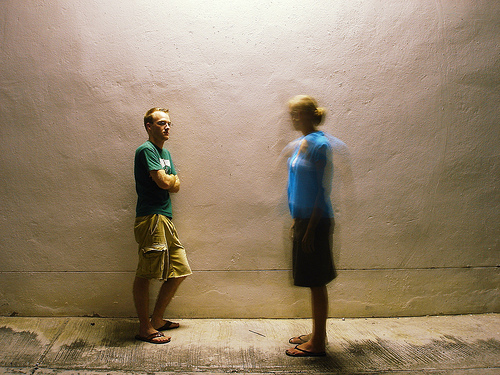
    The concept of audience has been on my mind ever since I started guest blogging at Bitch.  Their audience isn’t the same as GenMeh’s audience or True/Slant‘s audience. I’m still getting the hang of writing for an entirely new set of eyes and perspectives. At a more concrete level, the very candid replies to my recent column about how living so publicly condemns us to always making comparisons with our peers reminded me of the audience issue again. As did this article and spending yesterday afternoon doing a photo shoot with a friend for a side project I’m working on.

    Photo by B Rosen

    Often, there’s a significant disparity between who we think is watching us (everyone) and who is actually tuned in (not everyone, not by a long shot).  Same goes for the way that they view us and form opinions on our lives. Hint: it  lacks the intensity, fervor or level of emotional investment that we assume our every move and choice commands. I told myself this while lying perfectly still on a subway grate (in a dress no less) pretending to be dead for the sake of art. The truth is that we have far fewer devoted followers of our lives than our egos would care to have us admit and we are much less compelling to the world at large than we think. Our exploits aren’t keeping other people up at night (well, unless they are and I THINK YOU KNOW WHAT I MEAN. WINK, WINK, NUDGE, NUDGE). The increasing (voluntarily and otherwise) publification of our lives coupled with the evolution of celebrity gossip into a form of surveillance (vs. entertainment info) and a major component of the 24/7 new cycle has warped our perceptions of who’s keeping an eye on us and just how much they care. We are not walking-talking newsfeeds, as much as it might feel so.

    It’s a double-edged sword, really. On one hand, it’s comforting to realize that the rest of the population hardly notices if our zipper is down or we have a lisp or that time we tripped on the curb and spilled our grande frappuccino all over a parking meter. On the other, there is something uncomfortably  and acutely humbling about also realizing that our greatest triumphs, the ideas that set us on fire aren’t all that earth-shattering or interesting or even accessible to people outside our immediate circle and that the energy we pour into exciting these people, wooing them with our enthusiasm, secretly fantasizing about inspiring their epic envy is more than likely for naught (in the words of that eloquent late 20th century philosopher, S. Twain, “That don’t impress me much”). They might nod reassuringly or wish us luck on our endeavors or like our Facebook status in which we proclaim that we’ve been accepted at La Sorbonne, but they really don’t care. They’re frankly too busy with their own triumphs and fire-starting ideas that they find infinitely more interesting and engaging than our own.

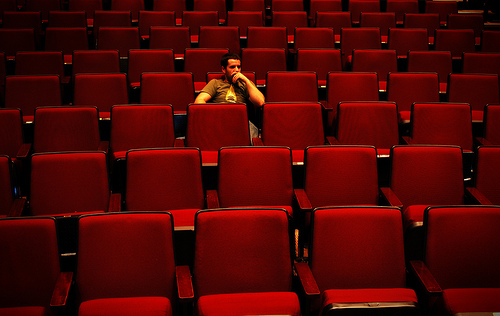
    Your world isn’t filled with an endless audience of would-be critics and/or fanboys. In fact, when it comes to audiences, the theater is pretty much empty. Liberating? Disappointing? True.

    *On my shortlist of titles for the future book, so back off, kiddos.

  • I’ve been thinking a lot about going along to get along in the last few days. How we’re conditioned to stifle our impulses for the greater good of society. It reminds me of a conversation I had with friends recently as to what our end-of-the-world crimes would be. If everything was about to go kaput, how would we defy law and order as the clock ticked down? They chose stealing (but when would you have time to enjoy the loot?). I naturally went for blowing things up. Or perhaps the more intimate violence of punching people in the throat. Repeatedly. And really hard.

    Photo by Michael Sarver

    And while we would never do these things in our regular lives, it isn’t just primal destructive urges that we suppress. We tell our friend her new haircut makes her look like an adorable pixie instead of asking her if she went to Simon Cowell’s barber.  We don’t chastise our boss about his poor dental hygiene. We refrain from hitting on our former frat brother’s totally hot fiancee. We exercise self control. I’m a big champion of the dead to me approach wherein you simply banish offenders to your intellectual or emotional Siberia without ever bothering to hit them with a laundry list of their sins, but, sometimes, we take the whole biting our tongue thing too far. We opt not to speak up when we really ought to. In order not to rock the boat, we stay silent when people disrespect us, disregard our feelings, breach our trust. Deciding when to simply cut them off and walk away vs. voicing our hurt is a tricky decision that depends on a number of factors:

    What’s your relationship to this person?

    Is this someone you interact with regularly? Who hold the balance of power in the relationship? If you’re never likely to see him again, is getting in a shouting match with the guy who shoved in front of you in the concession line at Fenway Park really productive or worth your energy? Or what about if your thesis adviser has an ugly habit of pitting students against one another? As unpleasant as her methods might be, what is your recourse and will pursuing it leave you better off or in a more disadvantaged position than if you simply refused to get sucked into the competition?

    On the other hand, in a close relationship of equals, allowing resentment and hurt to fester makes much less sense and will eventually out itself. If you see yourself with your current partner in the long term, then the upset you feel every time he cuts you off mid-sentence to change the subject is something that needs to be addressed.

    How likely is it that they can or will make changes to their behavior?

    Believe it or not, there are actually individuals out there who are mature and self-actualized enough that they’d want to know if their words or actions were unintentionally or inadvertently hurting someone they cared about. These are the kind of people you can air your grievance with and know that even if they don’t like what they hear, they will treat what you’ve said seriously and reflect on it. And there are other people who will offer you a lavish apology, swear never to offend again and blithely revert back to their old ways before your head is turned. These are the kind of folks on whom it isn’t worth wasting your breath (or energy). They’re not interested in righting a wrong or examining their conscience, they simply want you to quit being pissed off at them and will offer you whatever bland pronouncements of contrition are most likely to defuse the situation.

    What are the consequences for you, for them and for others if you don’t say anything?

    Are you going to continue to be hurt by the same behavior if you let this incident go unchecked? Are they going to hurt others in the same way in the future? Themselves? If you think your friend’s casual disregard for punctuality is eventually going to be an issue in the workplace and affect her chances for a promotion, maybe that’s the impetus for speaking up to say how frustrating and disrespectful it is when she’s chronically lately for your weekly coffee date. We can often overlook an isolated careless remark, a bad day, etc., but if the incident in question is part of a larger pattern of being hurt or treated poorly and is likely to keep happening until and unless you stop it, self-preservation of your own sanity and self-esteem might be just the motivation you need for flagging the issue.

    What does your gut tell you?

    Often, this is the deciding factor. Sometimes, for your own peace of mind, you have to take a stand. Nothing will come of it, no change, no apology, it might even muddy the waters further, but you simply need to speak out. And sometimes, even when the person deserves to be emotionally eviscerated, you refrain, shrug your shoulders and decide to let karma handle this one.

  • A few months ago, I wrote about 2010 being the Year of The Guinea Pig. I thought this was an appropriate juncture to revisit the topic and update you with lessons that I’ve gleaned from the experience to date. It’s not an exhaustive list and some of these points deserve (and will get) their own future posts.

    Photo by palindrome6996

    • Context is critical. I hear that a lot with respect to online content, but it applies even more so to life in general. How much easier is it to take chances, risks, be innovative, whimsical, bold, etc. when you’re living a lifestyle that supports this approach and are surrounded by people (heck, even having one is a huge step up) who are doing likewise? Answer: immeasurably. I will devote a post to this in the near future.
    • Meet every instance of hesitancy or doubt with “What’s the worst case scenario?” and refuse to accept, “I might look or feel stupid or be rejected.” as a strong enough answer to dissuade you from forging ahead. Eventually, you develop calluses on your ego that buffer the sting of rejection, anyway. And the more callused you are, the more you can put yourself out there on a bigger and grander scale and be okay with being shrugged off. Or so says the girl who sent an email to the managing editor of a national publication informing her that she absolutely needed to hire me as a columnist. She apparently didn’t agree. C’est la vie, kiddos.
    • We all have a thing that we’re fiercely possessive and territorial about.  Much better that thing should be a ratty old teddy bear from your infancy than, say, the very public craft of writing itself.  Just saying.
    • When the going gets tough, the tough score tickets to see a-ha. And every time they look at the tickets, they start to giggle.
    • One big project is better for your sanity than multiple smaller ones and usually produces a bigger impact than splitting your attention between all of the potential irons in the fire.
    • Wisconsinite is apparently an insult on par with being called an anti-sex homophobe. Bet you didn’t know that.
    • It’s a tit-for-tat world. It really, really is. You will have to give something of yourself (your time, your attention, your talent, your engagement with the rest of humanity) in order to receive anything in return. Call it taking a risk, reaching out, getting the ball rolling, but you will have to initiate some sort of action in order to see change or movement. Good things don’t just come to those who pine for them while sitting on their sofa. I think this deserves its own discussion as well.
    • Keep notes. Always.
    • If you’re young, female, single and straight, you might want to do a little cursory research before packing up and moving to a city whose male population is seemingly 85% gay.
    • Sometimes, Life plays hard to get and you’ve gotta make the first move. And the second. And the third. Don’t sweat it, eventually your charm will wear it down and it will give up the goods. Or take out a restraining order.
    • There will always be vacuous/annoying/shallow/mercenary/unflattering adjective of your choice folks who have achieved or have been gifted with things you want. Don’t focus on the fact that they don’t deserve these things, focus on how you can get them for yourself. In fact, stop focusing on these people entirely. Do not follow their progress, don’t analyze their path and its “lessons,” don’t try to connect with them, etc. Pretend they don’t exist and keep doing things your way. When the hell has stewing over cosmic injustice without any intention of taking steps to rectify or address it actually improved the quality of anyone’s life or helped their blood pressure? It hasn’t. Ever. Let it go.
    • The Junior League doesn’t want me. I sent them an email about info on joining a couple of months ago and still haven’t received a response. It’s because the only pearls I own are plastic and cost me $1.99 at Claire’s, isn’t it?
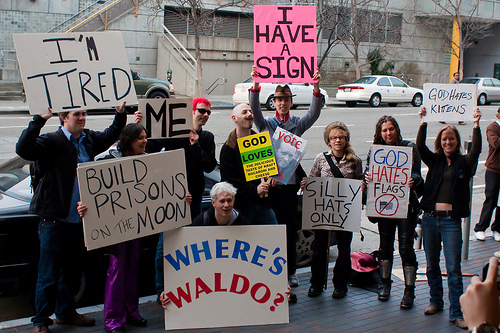
  • You’ve all heard the expression that when all you’ve got is a hammer, everything looks like a nail? Well, the same logic applies to interventions from the universe. When all you want is a sign, potential signs are all that you can see. A song on the radio, an article in the newspaper, a quarter on the ground. Sign, sign, everywhere a sign. Indeed.

    Photo by Rubin 110

    We know what we should do or want to do or shouldn’t do or don’t want to do, but we’re waiting on that little push, that cosmic rubber stamp, something to reinforce our own instinct (or lack thereof), to reassure us that there are rhymes and reasons and most importantly, that there are right and wrong choices to make or paths to embark on. We crave the simple morality of this is what’s best or being saved from yourself and while that knowledge is surely within us to be tapped, we still prize the outside perspective or opinion more highly. It’s comforting to think the world has your back or at least your best interests at heart.

    What strikes me as funny is that as often as we look for signs or implore the universe to validate us, we have a habit of ignoring those signs that we do receive and can easily decode without a cosmic script. Signs that you’re dating a cheater, that your current career path isn’t in line with your values or long-term goals, signs that that nagging cough or suspicious lump should really be checked out, etc. We’re adept at disregarding the signs that don’t tell us what we want to hear while we’re urgently scanning the horizon for ones that will reinforce our impulses or take the burden of responsibility for choosing a direction (and the accountability for pursuing said direction and its consequences) out of our hands.

    We already know the answers or know how to find them, but that requires trusting our own gut, doing our homework, taking a risk and believing that we can survive the fallout (should it come to that). But where’s the security, the comfort, the perceived certitude in that? Better to hand it over to the universe and trust what the tea leaves tell us. Really, who needs good judgment and personal autonomy when a string of tenuously-linked coincidences will do?

  • The word vulnerable usually gives me hives. I’ve spent years avoiding it. In fact, one of the best compliments that I’ve ever received from a dear friend of mine was when she said that of all the people she knows, I’m one of the most sure of myself. So, why am I advocating vulnerability today? Why am I telling you to stand under a (figurative) tree in a (figurative) thunderstorm and wait for the (very real) lightning to hit you? Because, sometimes, it’s necessary.

    Photo by Dan Barak

    I’m not talking about vulnerability in terms of tearing your heart out of your chest and pinning it to your sleeve, dropping “I love you” on the third date, going to bed at night with your front door unlocked and your brand-new iPad clearly visible on the dining room table. I’m talking about taking off the bullet-proof vest. I’m talking about being glue to the universe’s rubber and simply waiting to see what bounces off of it and sticks to you. It’s about resisting the instinctual urge to give in to your tried and true knee-jerk reaction to conflict, criticism or being confounded and allowing yourself to feel confused or at odds instead. It’s about admitting that despite living all the years of your life in this body and this mind that you might not know what’s best for both 100% of the time. It’s about being able to say that you genuinely don’t know the answer and trusting that being thusly stumped doesn’t meant that everything is going to immediately cave in around you.

    It’s scary as hell to contemplate, especially if you’ve been making your way in this world based on moxie, on grit, on the ability to sell your confidence and poise to anyone, whether they were originally intending to buy or not. Letting go of that, even temporarily, is hard. Doing that and letting the world take a good long look at what’s really beneath and not flinching when it tells you (in a variety of voices) what it sees is even harder. And being open enough to examine what these conclusions are and their validity is pretty much the holy grail of humbling yourself. But ultimately, it’s worth the effort. I’ve written before about the downside of the whole smile though your heart is breaking school of thought, but I think being fixated on demonstrating your unimpeachable self sufficiency and iron-grip causes its own kind of damage, even if it’s more difficult to detect. It breeds a certain sort of personal isolation, creates an aura of surety that people might respect and envy, but they don’t necessarily relate to. They simply assume you’ve got everything cased and move on to focusing their attention on folks with whom they can find common ground in flawed humanity. And the longer you meticulously focus on patching every crack in your public foundation and putting your best face forward at all times, the more difficult it becomes to step away from that mindset and the more frightening it becomes to contemplate maybe leaving the cracks as is or even asking someone else to give you a hand in fixing them.

    Bottom line?  As much as leaving your decision-making to a majority vote is inadvisable, so is plowing through life like a one-person wrecking crew, unable or unwilling to take or seek counsel from others because that would mean admitting you actually wanted that counsel in the first place. Sometimes, we all need a fresh perspective or honest feedback or simply to stop running our internal monologues long enough to soak up some much-needed silence. But, you’re not going to get the help you don’t ask for and won’t allow into your life. It’s not about being needy, it’s about being receptive.  And being receptive means being vulnerable, being exposed and maybe getting hit with a bolt from the blue.

  • A Dream Deferred

    What happens to a dream deferred?

    Does it dry up
    like a raisin in the sun?
    Or fester like a sore–
    And then run?
    Does it stink like rotten meat?
    Or crust and sugar over–
    like a syrupy sweet?

    Maybe it just sags
    like a heavy load.

    Or does it explode?

    -Langston Hughes

    Our unrealized dreams come with an expiry date, a point beyond which we need to acknowledge that they will not feasibly be achieved. No one wants to face that and I don’t particularly want to be the one to tell you, but it’s true. Of course, this date isn’t neatly stamped on the package. And the trick to figuring out exactly when to throw in the towel is one that we spend our whole lives trying to get the hang of. There’s a fine line between too little and too much, too soon and too late, between giving it your all and going down with the ship. And there are no hard and fast rules for discovering this line. Mostly, it’s the process of trial and error, with our own cherished aspirations as the testing grounds (the poignant pain of hindsight has truly launched a thousand literary ships).  And the whole hope thing doesn’t exactly make it easier to figure out when to hang in there and when to cut our losses.

    Photo by toddwshaffer

    Hope is a hallmark of humanity. Hope is what elects presidents, gets us through the scariest of health issues, fuels those with missing loved ones to never abandon the possibility of a happy ending, or at least closure. But hope can also blind us to harsh truths, keep us running toward a mirage in the desert that doesn’t exist. The idea of the sun coming out tomorrow is a seductive one and we’re sure that if we hang on for one more tomorrow, there will finally be a break in the clouds. We can feel it. But what if it never happens? When is enough enough?

    The question is meant rhetorically, but I will offer you a practical means of tackling it. Conduct periodic and brutally frank gut checks. Is the act of pursuing the dream/goal bringing you happiness or are you simply gritting your teeth throughout it and clinging to the specter of future contentment or pay-off to get you through*? That’s a lousy way to live, FYI. What have you given up in service of this dream (relationships, creature comforts, financial stability, etc.)? Do you miss these things? Would the addition of them improve the quality of your life? Could you imagine being happy with something else other than the dream? Could you see yourself building a satisfying life as a junior high school drama teacher and not a Broadway actor? Can you acknowledge the possibility of a future with someone other than the college girlfriend who broke up with you three years ago and whose emails you still haven’t been able to delete? If so, you owe it to yourself to explore these options. It’s not quitting or settling, it’s maximizing your current situation to wring the most attainable happiness out of life that you possibly can.

    We’ve come to hold dreams and ambitions as almost sacrosanct (it’s the American  way after all), but when they always hang that little bit out of our grasp, when we’re always almost (but not quite) able to reach out to touch them, they and the unrequited hope we hold for achieving them damn us to always being unsatisfied or unfulfilled, no matter what other abundance and good fortune might surround us. When you realize the time is right, it’s okay to stop reaching. Really.

    *If so, please read some Max Weber and then get back to me.

  • I write a lot about not being too hard on yourself, but I rarely look at the other side of the coin, namely how our fear of pain/discomfort/effort/ambiguity often leads us to choose the path of most expediency or least resistance.

    I think I’ve admitted before that I’m one of those annoying folks who doesn’t have a tv. I don’t, however, let this stop me from watching The Biggest Loser on my laptop.  An odd choice of guilty pleasure viewing for someone who preaches the gospel of body positivity, but I justify it by the fact A) that these folks are losing weight for health and quality of life reasons (vs. vanity or societal pressure) and B) the firm belief that Jillian Michaels and I would no doubt get along splendidly in real life.

    Photo by Brian L. Romig

    The Biggest Loser focuses a significant portion of each episode on forcing contestants to confront and surpass their perceived physical limitations. So, you think you can’t run for two minutes? Well, we’re gonna do 10! Predictably, there is doubt, resistance, tears and drama, but, in the end, the challenge is typically met and the contestants offers up a glowing testimonial about how they never thought they could do what they just did and now that they’ve conquered this feat, well, the sky is the limit. The Biggest Loser typifies the no pain, no gain (or rather, no loss) mentality and while the focus is on the physical self, there is also plenty of effort devoted to armchair psychoanalyzing (conducted by the aforementioned Ms. Michaels in most cases) the contestants and the factors that drove them to morbid obesity, with the logic being that you don’t gain 150 – 300 lbs without attempting to avoid dealing with something or a lot of somethings.

    While we might not show the same physical consequences, we are most likely guilty of the same desire to duck pain at all costs that drives TBL contestants to turn to food. But emotional pain isn’t the worst thing in the world and fear is a poor motivator for decision-making (an outlook I wholeheartedly share with a reader who recently emailed me). Sometimes, feeling our way through pain and fear is exactly what we need to do, both to learn that we are indeed strong enough to survive it (it ain’t exactly goin’ out of style any time soon) and to make decisions that are based on embracing what we genuinely believe will make us happier vs. simply evading short-term uncertainty and discomfort.

    And sometimes, we don’t need unqualified support and cheerleading. We need a devil’s advocate, someone who will force us to examine and spell out our assumptions, ask the questions that force us to confront the whole truth and nothing but the truth, who won’t give us a free pass. This is especially true for those who are talented in the realm of talking a good game and putting on a good show. Speak with enough authority and few will question, even if that’s exactly what you most need them to do.

    When it comes to life, sometimes, it’s supposed to hurt. Doesn’t mean you’re doing it wrong.
  • Hate To Break It To You is a recurring feature wherein we dispense succinct home truths that everyone could benefit from facing up to, unpleasant as they may be.

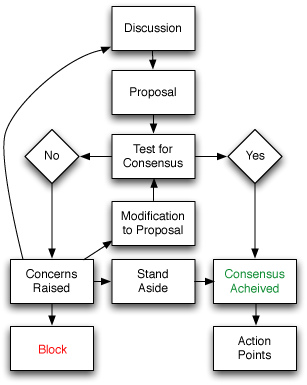
    Your life can’t be lived by consensus. I was reminded of this yesterday when I was A) encouraged to be a little more revelatory on GenMeh and B) dealing with a troll over at Bitch who was all over me for doing just that in my column there. More or less simultaneously. Heh. Good thing I’m not a people pleaser, right?

    Photo by dsleeter_2000

    You can never achieve perfect harmony between the decisions you make and a universally positive response they may elicit from others. And why would you want to? Well, we all know why you’d want to. There’s safety in numbers, there’s a soothing balm to knowing that you and your choices have been thoroughly vetted and deemed worthy/correct/appropriate by those in the know (everyone from your great uncle to your college roommate to internet strangers and the checkout clerk at Whole Foods). Adios, insecurity and ambiguity.

    And many of us expend an awful lot of time and energy on convincing others of the rightness of our decisions, as if their approval could actually strengthen the quality of the choice itself, or somehow validate it as the correct path. And surely there are brownie points (or perhaps, actual brownies?) for winning over the hold-out naysayers? For using your powers of persuasion and Martin Luther King level rhetorical skills to break down their resistance and bring them onside? Don’t hold your breath.

    What if we channeled this energy (both physical and psychic) into building confidence in our own judgment, into dissecting and overcoming the fear(s) that makes us depend on others to rubber stamp our intentions, into developing skills and strategies for coping with the repercussions of choices that don’t pan out as expected (hint: the world will probably still keep spinning if you drop out of grad school). Because all of the folks who gave you the thumbs up in the moment? Well, if your decision happens to go south, rest assured they won’t be sharing in the accountability. You’re gonna wear this one, so you might as well make the decision that you can live with, not the one that makes it easier to live with others.

    Seek advice, do your homework, but trust your gut over a straw poll.

  • List Served is a semi-regular feature wherein I present you with an ordered grouping of (at least tangentially) related points. I love lists and the internet loves ephemeral minutiae. It’s all good.

    A Sampling of Thoughts Crossing My Mind in the Wee Small Hours of The Morning When I Should Be Sleeping, But Haven’t Been for the Last Month

    • Trying to remember the name of the actress who played the doctor’s secretary on Empty Nest
    • Why, even if it says scent-free, sunscreen always has that smell to it
    • How far I could get in 24 hours via Amtrak
    • Potential occupations of my neighbor based on the assorted items he leaves outside of his apartment door. I’ve settled on hipster stuntman
    • How proud of I am of the fact that my bedroom window covering is actually made from a repurposed shower curtain and YOU TOTALLY CAN’T TELL BY LOOKING AT IT
    • My worrying new love for caps lock
    • The relative merits of playground tire swings vs. regular playground swings. Regular swings still win, FYI
    • The fact that I can never remember how to spell petechia, or why I’d even need to know this
    • Exactly how hard it would be to grow a kombucha mother from scratch and what the odds would be of accidentally poisoning myself with the resultant tea. And would the risk be worth it?
    • I’m aware that something happened on the way to heaven, but why doesn’t Phil Collins ever clarify what it was?

    P.S. I’ve announced it in other venues (Twitter, facebook, an ad in Variety), but I’ll be taking on a new gig for April and May, namely guest blogging for Bitch Magazine on issues of youth identity, socieconomics, pop culture and post-millennial angst. So, in addition to your regularly-scheduled GenMeh and Warp and Weft programming, you can check out The Young and The Feckless on Mondays, Wednesdays and Fridays if you’re so inclined.