• Imagine 25 people (strangers, even) all staring at you while they throw out words and terms to describe their perceptions of you and then more words and terms for areas you need to work on. And you just have to sit there and absorb it. That was my Sunday. It was challenging. Not because I was surprised by what words came up, (I could have predicted most of them), but the not being able to argue or defend myself or explain why when you say you see A, it’s really B. I took it less personally than others, just crawled into the mental storm cellar, closed the hatch and waited until it was safe to pop my head back out.  I did appreciate that the feedback was framed in terms of what qualities the group recognized that you possess and wanted to see more of from you and not simply telling you to be less timid/pushy/loud/insert adjective here.

    Photo by confidence, comely.

    The end result of the exercise (only a few of us got the full group treatment, the rest had their profiling in clusters of four or five) was that everyone ended up with a name tag that had a word or descriptor to dictate how you should conduct yourself for the rest of the day. Mine was one of the few name tags that called on the bearer to emphasize softness, vulnerability and touchy feely stuff (the older man who ended up with Casanova also comes to mind). The majority focused on encouraging participants to be bolder, more assertive, more selfish, more confident (Tiger! Xena! Wonder Woman! Boxer!). I couldn’t help but be a little jealous. It seemed a much easier task to simply front as if you have natural swagger than shift into nurturing earth mother mode if that doesn’t come naturally.

    The point of the exercise was about achieving a balance. We’re all adept at tapping into and projecting certain aspects of our character. Call it our comfort zone, wheelhouse, whatever. But we’re more than that narrow range, the name tags were meant to assert. Venturing farther afield to bring out child-like wonder or no-nonsense straight-talking might feel foreign or artificial, but it’s possible. Those capacities are underdeveloped and maybe even undiscovered, but we can go there and doing so in a space where we won’t be called out or socially penalized for getting it wrong or screwing up is absolutely the right context for taking the first few halting steps in this direction. That safety for fail-proof experimentation is a luxury I wish more people had access to.

    And that’s where I come in. Our whole lives are spent attempting to be in the world and to figure out what that looks like for us when it comes to relationships, jobs, self-esteem, etc. Is it making ourselves as small as possible, trying to fly under the radar and praying that we won’t be tramped all over or singled out? Is it puffing our chests out, peeing all over every telephone pole, fire hydrant and shrub in our path to mark our territory and rush to define ourselves before anyone can do that for us? The colonized or the colonizer? I know now that what I want to do, what I feel absolutely compelled to do is to work with people to support them in striking a balance (i.e., you don’t have to be the imperialist or the conquered. Maybe a nice Canada or Switzerland instead?) and defining/designing that space for themselves  in a concrete, positive, practical way and without jargon, new age BS or patronizing affirmations. What does okay look like and what will it take to get you there? What do you need to feel at ease in the world and how can we work together to get you those resources? How can I help YOU? Working with people to answer these questions is what’s most important to me right now. It’s what I want to do, what I feel (oh God, do I have a heart after all?) I need to do.

    And that realization was so worth wearing a silly name tag for a few hours.

    *Okay, I lied. No hugs here. Yet.

  • List Served is a semi-regular feature wherein I present you with an ordered grouping of (at least tangentially) related points. I love lists and the internet loves ephemeral minutiae. It’s all good.

    Photo by Darwin70

    • Accept a compliment
    • Ask for help without shame or anxiety
    • Name their children
    • Identify when to use lose vs. loose
    • Say no without overapologizing or making long-winded excuses
    • Tell a story without stepping all over the punchline
    • Correctly identify roman numerals
    • Budget, or even think about financial planning without breaking out into a sweat
    • Answer the questions, “What kind of music do you like?” and “Where do you see yourself in five or ten years?” without becoming a stammering mess
    • Tell time with a sundial
    • Throw a split-finger fastball
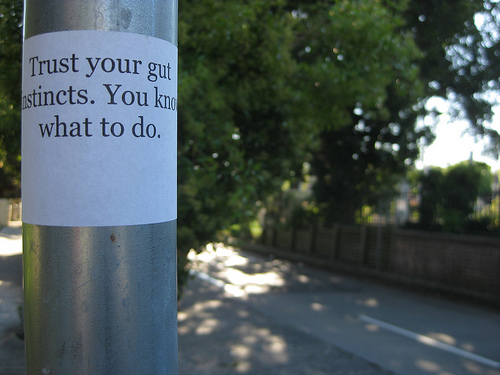
  • Gen Y has no gut instinct. Or so I declared late last night (N.B. When  in the throes of insomnia, I sometimes throw out bold declarations and unfiltered non sequiturs on Twitter). On the whole, we’ve never made developing our intuition and using it as a guide in decision-making much of a priority. And why would we? Sources of information to check and double check our options against the “norm,” against the paths chosen by our peers, against the advice offered up by four out of five dentists is everywhere. When do we actually fly blind?

    Photo by KayVee.INC

    But even if we’re never faced with the prospect of being trapped in an avalanche and having to weigh the pros and cons of self-amputating a crushed arm as a means of facilitating an escape (pro: More mobility! con: Dying of sepsis!), it pays to have have the ability to take ownership of our decisions and to be able to put our faith in what our accumulated experience, intuition and overarching values tell us vs. allowing the majority to rule our lives.

    The good news is that gut instinct can be developed, even for those of you born figuratively gutless. It’s a repetitive process of performing a post-mortem on decisions, noting how difficult or easy it was to come to the decision, the outcomes of the decision and how they did or didn’t match up with your expectations. Lather, rinse, repeat. File this information away. Dig it out the next time you have to make a decision and look for similarities between those circumstances and the present ones. Do you feel the same sense of dread about buying this condo that you felt about taking that I.T. job in New Haven? If the latter decision didn’t pan out and you can identify commonalities between it and your current conundrum, those red flags represent your gut trying to send you a message. Heed its warnings and proceed with caution.

    Honing your gut instinct is a trial and error process. It involves exposing yourself to the possibility of failure and dealing with the consequences in a deliberate, measured way. Not going to pieces, not blaming yourself, not vowing to never take another risk so help you God as long as you shall live, but mining each disappointment, heartbreak or personal implosion for the information mentioned above and being willing to examine failure not as a reflection on your self-worth, but a rich capsule of useful experiential data – choices made and not made, input sought and feedback discounted and on and on.

    Developing a gut instinct is one thing. With enough time and effort and willingness to make and implement decisions which may not work, we can all cultivate or tap into natural intuition, but relying on it is a whole ‘nother ballgame. We live crowdsourced lives. Google (or Facebook/Twitter/LinkedIn stalk) your blind date, check Yelp for the 411 on that new restaurant or Rotten Tomatoes to see what the critics have to say about this week’s new releases, poll friends and family and when all else fails, there’s probably an app for that. We’re surrounded by so much information and opinion that we’ve deprioritized our own experience and feelings (sometimes entirely unconsciously), especially in the face of overwhelming evidence that we’re not on the same page as everyone else. Be a lonely outlier, or adjust your perspective to conform to the baseline and use the ready pipeline of public opinion data, product reviews, polemics, sales figures, celebrity endorsements, etc. as a proxy for a hard and fast ruling from the pit of your own stomach? Not much of a choice if you’ve never bothered to cultivate your own intuition to the point of trusting it over the wisdom of the crowd.  But if you do develop it, eventually, that gut instinct is gonna come in very, very handy. There will come a time when the crowd gets it wrong, when something looks good on paper, but just feels off to you, when you’ll be faced with a decision for which there is no precedent and which is so deeply personal that only you can be the one to decide it. Back against the wall and it’s nothin’ but gut.  And you’re going to be glad your instincts are  there for you when that time comes. I guarantee it.

  • The other day, I was trying to explain to a friend why a recent concert left me disappointed. The crowd was great (save for the tall girls standing directly in front me of me – the pains of being a short live music fan, I suppose), the performer in question actually sounded better live than recorded, I got to hear the song I was most looking forward to and yet… The best I could come up with was that the whole show seemed rote. She-who-shall-not-be-named seemed to be reading from a script, banter that had been delivered a thousand times before, an insistence on micro-managing the audience’s participation, a little too much preening over a carefully-cultivated “quirky” image. It all added up to a manufactured whole that left me cold. There was nothing organic about.

    Photo by kumasawa

    Ah yes, the O word. I’m organic all the way (well, not when it comes to produce, but still). I find something elegant, something literary, downright romantic (small r) about connections and opportunities emerging from serendipity and I’m reluctant to let go of the notion that your words and actions should speak for themselves, should reveal your skills and the content of your character and should be the grounds on which people evaluate you and your potential as a friend/employee/partner/human being vs. your ability to leverage, promote, monetize, and god forbid, brand yourself and your talents. I know, how terribly quaint of me. I’m sure this is why I don’t have a book deal yet (and maybe why I’m single. Heh). To put it in baseball terms, while a sac bunt might get the job done, I’m always gonna be a (swing from the heels) home run kinda girl.

    Refusing to self-shill or to treat success as the product of five easy steps you learned from a book, webinar or from some dude who spoke at your convocation doesn’t mean that you don’t have to grind things out or hustle. It simply means that you hustle after and capitalize upon those opportunities and openings that have genuine appeal to you (the wanna over the shoulda) and you do so in a manner that feels natural (or organic if you prefer) to you. You stop  thinking in terms of adding value, connecting with, meaningfully engaging, etc. You start thinking, feeling and acting like a $#@%^ person and not a programmed successbot, ya dig?

    It also means that you ditch the damn metrics.  Twitter followers, page views, LinkedIn connections, how many business cards you gave out this week, whatever arbitrary measure of getting ‘er done that you’ve been using as proof that you’re already on step six of the eight steps needed to reach entrepreneurial rockstardom. Instead, why not spend time figuring out what your values are and whether or not it’s actually possible to enact them and measure the outcomes of these actions according to an 11-part system developed by an internet famous “expert” who charges $159 a pop for repackaged advice that you could have picked up by thumbing through Gilbreth’s Cheaper by the Dozen?

    Keeping the faith in the organic isn’t always easy, especially when you see the strategists and systems-lovers seemingly reaping rewards for their ability to stick to the game plan and when you hear the same refrain from every quarter exhorting you to get on board with the way things are done now, while subtly inculcating the fear that if you aren’t reaching out, linking in and pouring the prescribed amount of time and effort into creating Brand You, that you can expect to be eaten alive by those who got the memo. But it’s not about them. It’s not even about the culture of success architecture. It’s about the fact that you have to live your life in your shoes and that you deserve more credit for knowing how to engage with the rest of humanity on terms that reflect who you are and who you want to be than to have to rely on a vacuous, buzz-laden script just because it makes you feel as if you’re checking all the right boxes. And if you won’t give yourself that much credit, I certainly will.

  • There is a scene in the remake of Grey Gardens where Big Edie refers to Little Edie (her daughter) as an “acquired taste.”  It’s meant to be contemptuous and passive-aggressively manipulative and controlling (the hallmark of their dysfunctional relationship), but it gets at the heart of the fear that so many of us secretly harbor – that we’re too whatever (weird, homely, crazy, damaged, inadequate, poor, etc.) to find happiness, acceptance and fulfillment in our romantic and working lives, that we’re too far to either end of the bell curve to be saved.

    Photo by carianoff

    But, really,  what’s wrong with being an acquired taste? Tofu, kombucha, absinthe and sauerkraut are acquired tastes and if you don’t like ’em, well, more for those of us who do (NB: I’ve never actually tried absinthe). Unfortunately, we’ve been socialized to believe or convinced ourselves that our value is in broad-scale appeal. We should be liked and desired by all, with bonus points for winning over those who would ordinarily remain immune to our professional or personal charms (why else would the ability to sell ice to the Eskimos be touted as a killer quality?). But it’s a fool’s errand. You can’t please all of the people (the potential partners, employers, friends, coworkers) all of the time and attempting to mass market yourself gets downright exhausting. Face it, we can’t all be Coca Cola, can we? And even if we could, there’d always be folks who’d prefer Faygo.

    So what’s the alternative? It’s realizing that being an acquired taste is not only the reality, but it’s a pretty palatable one at that. Your prospects aren’t nearly as dim as they seem should you choose to specialize. It’s a big ol’ world and even if 99.9% of the planet’s population find you completely unattractive or undesirable, that would still leave 6 800 000  souls interested in getting all up in your space in a platonic or romantic way. Hell, even if you appealed to only 0.01% of global citizens, that would be 680 000 potential pals or mates (you can split it 50/50 if the gender binary is your deal). Those are numbers that would cause Wilt Chamberlain to weep from exhaustion.

    Being an acquired taste and having acquired tastes of your own involves finding a match between what you want and which markets (be they of the labor or dating pool variety) are most likely to want you. You don’t pull up to the McDonald’s drive-thru and assume you can order filet mignon, do you? So why would you expect that a cubicle job would satisfy you if you love being outdoors and do your best work between 2:00 and 11:00 PM? Or that the woman giving you the eye in the Starbucks line would be totally open and supportive of your interest in cross dressing? Maybe she is, but instead of pinning your hopes on stumbling across a kindred soul within the leagues of the population at large, isn’t it so much more efficient to target the contexts, fora, subcultures and social spaces most likely to feature collections of simpatico individuals? Beats the hell out of bemoaning the fact that the dude you gave your number to at a NASCAR race has never heard of Noam Chomsky and prefers his beer domestic thankyouverymuch or that BYU’s grooming standards are putting a serious crimp in your plan to grow some righteous mutton chops.

    People and jobs can defy your expectations and their contexts, absolutely, but if you’re going to be purposive about marketing yourself professionally and personally (and maybe that’s not your bag, fair enough), you’ll need to commit to a target market and focus your energy there. If you want something outside of the ordinary, you’re going to have to go outside of the ordinary to get it. No more trying to “make it work” by applying for public sector jobs when the thought of being a bureaucrat makes you hyperventilate at the strictures. No more assuming that your awesomeness or that of the object of your affection can trump fundamental disagreements over core values and life outlooks. No more expecting that you can be all things to all people and tying your worth to a majority vote. No more trying to fit square pegs in round, triangular or octagonal holes for the sake of convenience or duty.

    Accept that you’re Rock and Rye and go from there.

  • The very first interview I did for GenMeh turned out to be oddly prophetic. The Board of Love girls were pretty pithy, but their advice about the need to seek out and assemble support systems for various facets of your life is indisputably solid. We’re social creatures and even the most ambitious, motivated and fiercely independent among us (shoutout to TM for this descriptor)  could benefit from some outside interference of the positive variety.

    Photo by ZeHawk

    Identifying when you need it and the type of support required (forget about actually asking for it), however, can be difficult and the latter absolutely varies according to your personality and the context you’re in.  Do you need a devil’s advocate? A shoulder to cry on? Someone to hold you accountable? A sounding board? One size of support doesn’t fit all people and situations ( break-ups and job hunts call for different support systems, for example).  In my case, I don’t need validation or cheerleading or even trouble-shooting and if you try to pat my shoulder, you’re probably gonna lose a hand. I’ve figured out that I need someone who will ask me tough questions, back me into a corner and force me to articulate all of my assumptions and get me to commit to doing X, Y, Z.  I’ve been working with a career coach for the last few months and it’s been very helpful on this front, especially given that I’m in the process of getting my own coaching/consulting  practice up and running (yeah, I’m letting the cat out of the bag. Email me if you’re curious).

    There’s also the little issue of the type of support you need differing from the type you want.  It’s so much more comforting to have folks coo over you and bring you ice cream vs. challenging to you smarten the hell up and start drafting a plan for how you’re going to get from A to B, isn’t it? Even if the former simply encourages self-pity and reinforces the patterns of thinking and behavior that brought you to the point of needing someone to show up at your door with a pint of Chunky Monkey in the first place. But if you want the best match between your goals and the support you need to tackle them, it pays to be absolutely ruthless in the evaluation of what your current system consists of and whether or not it can do that for you.  All the Chunky Monkey in the world isn’t going to help you fix the weaknesses in your business plan or revise your college admissions essay, ya dig? It’s not a knock on your friends and family if you have to seek guidance from outside your circle and it doesn’t make you weak or bourgeois or a sucker if you find that you need to seek out a professional for specialized support (i.e., career or life coaching, resume writing, counseling, etc.).  In fact, it’s downright naive and myopic to assume that your social circle should be a jack-of-all-trades when it comes to providing all of the external emotional and intellectual resources you might require or that you should be able to simply white-knuckle your way to success entirely solo. It’s all about finding a match between your identified needs and the scope of support options at your disposal.

    And you owe it to yourself to get it how and where you can.

  • The latest installment of the American Dream Essay Series (door is always open to submissions) comes to us from Chanelle Schneider. Also known as @WriterChanelle on Twitter, she runs her own blog at ToThereFromHere where she offers career and life advice for Generation Y, with a specific focus on those older GenYers who have yet to graduate from college. Chanelle is the founder of the generational chat #GenYChat on Twitter and manages the @GenYChat account. She is also a freelance writer and is currently working on a film script.

    Photo by Esther Gibbons

    The American Dream is only the American Dream for those who have been privileged enough to have access to the raw materials to construct their own. For those who don’t, the American Dream is a distant star in a sky filled with such similar platitudes as “a piece of the pie.” I want a piece of this pie. Where is it? Who baked it? How much does it cost? You know nothing is free.  “The way they get that slice is through education.

    The one thing that is supposed to be free?  Love. But even love is being monetized lately. Love and support go hand in hand. The key to obtaining this piece of the pie is in finding the support to build your dreams. Support can be pretty difficult to find, though.

    It would be quite altruistic of people to support everyone they loved. If love is supposed to be unconditional and granted a priori, then it would be sufficient to say it would be quite altruistic of people to support everyone. Since love is becoming a capitalist endeavor whereby one must have some measure of financial prosperity, or, at least, be headed toward it, support is getting harder and harder to come by. For those who have access, support is a given. For those on the bottom rung, support is hoped for and rarely received. For those in the middle, though, they assumed that support would be granted. In a society where upward mobility is often dependent upon the class you were born into, the American Dream is closely linked to financial success. Financial success is tied to employment. Employment is tied to ability. Or…wait. Is it?

    For example, I often wonder about the purpose of a resume, a tool that is supposed to be useful in identifying ability and talent. However, for most people the resume is a perfunctory document given after the connection is made to a potential employer. If jobs are found through your personal network by someone who has given you a recommendation, why is it necessary? The employer recognized your ability only after the support of someone in your network. Thus, employment is tied, first, to support, then to ability. And the American Dream hinges upon support. Obtaining it, though, leads directly into a Catch-22. When you’re part of the middle class, people want to support you only when it’s clear that you’re not a financial risk. Much like trying to obtain credit or a student loan without a history of repayment, you need a co-signer. The co-signer is willing to vouch for your future ability to repay (in dollars or productivity) the support. Without this support, it’s impossible to get further in the application process, and you have to wait until you can prove your ability on your own.

    And there are a lot of us out here who just can’t find that support for one reason or another.

    -Chanelle Schneider

  • Hate To Break It To You is a recurring feature wherein we dispense succinct home truths that everyone could benefit from facing up to, unpleasant as they may be.

    Photo by metal1944

    For all of our big talk about doing things on our own terms, defining and measuring our success by benchmarks other than the traditional, being less consumptive and more self-actualizing, Gen Y is remarkably puritanical when it comes enjoying the here and now sans guilt. We’ve got a punitive streak a mile wide and ain’t no one gonna convince me otherwise. If we haven’t made it yet, we don’t deserve to enjoy what we do have until we have made it, or so the thinking goes. Not only do we not have/make time to savor our current good fortune (nothing new, that’s been the MO of every 20th-century generation), but we don’t feel as if we even have the right to do so until we have more to show for our effort. The better to fall even more hopelessly behind others who eschew stopping and smelling the roses, my dear. All of the location independent, lifestyle-designing, nomadic cheerleading in the world isn’t worth jack until and unless it addresses the ghost of the Protestant work ethic that haunts us and influences our evaluation of self-worth. End of story.

    In our heart of hearts, many of us still believe that there’s something self indulgent, cavalier or heedless about taking time to enjoy the ride. Forget having a scavenger hunt in the park, or skipping town for a few days to visit family or live it up in NYC or even indulging in a weekly fancy-pants triple mocha, we should be blogging, networking, job hunting, overtiming, penny pinching, etc. Who are we to enjoy what we haven’t earned through sacrifice and character-building deprivation?

    But what if it takes us the next five years or ten years or a lifetime to feel as if we’ve “earned” our “success”? Talk about taking the long way around.  What exactly are we supposed to do in the interim? Live in austerity? Castigate ourselves with parochial guilt every time we take a time out for self-directed dilettantism? Gen Y talking heads claim that our cohort is all about the journey and not the destination, but how many folks are genuinely enjoying the trip?

  • List Served is a semi-regular feature wherein I present you with an ordered grouping of (at least tangentially) related points. I love lists and the internet loves ephemeral minutiae. It’s all good.

    Photo by foreversouls

    I’ve been more or less off the grid for the last week or so, but that doesn’t mean that life has been lacking in the edification department. Time spent visiting my family never fails to prove illuminating.

    Lessons Gleaned From Vacation

    • How to properly tease one’s hair
    • The difference between petunias and pansies
    • The difference between golf hot and regular hot
    • That my sister thought Cher wrote this song about Sandra Bullock’s husband
    • That my mother is a texting fiend. If we were back in telegraphing times, she would have been all over the Morse Code thing.
    • The wonder that is barbecued corn
    • The wonder that is spiked iced tea.  Rum is best, but vodka is pretty okay, too.
    • The correct method for splitting a pine log
    • That my parents’ elderly dog has a beef with me, as evidenced by the fact that she peed on my bed twice in the span of  a week
    • That comparing someone to a piece of raw chicken is an acceptable means of drawing attention to their paleness
  • Photo by cliff1066

    The next installment in GenMeh‘s American Dream Essay series comes to us courtesy of Bethany Moore. She describes her poetic inspiration as follows:

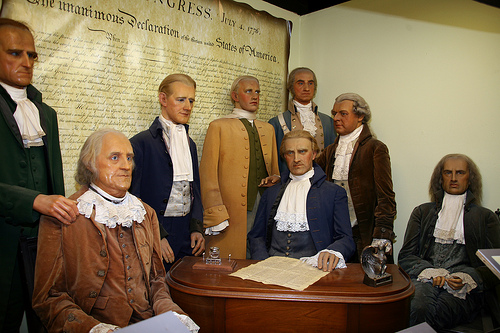
    The piece American Daughters was written when I was living & working in Washington DC as a church-state separation activist on Capitol Hill, and I’d occasionally feel full of piss and vinegar enough to write a poem like this about the frustrations of being a woman who is limited or even threatened by her own role in society.

    American Daughters

    Founding Fathers!
    Men of America who oversaw
    The birth of this country,

    Did you see it coming?
    By it, I mean us?
    Did you hear the cries
    Of this nation’s labor pains echo through
    the chambers of your declaration signing?

    Did you see us coming;
    The women, the mothers
    Of the people whom you
    Would govern?

    Did you see us in your vision?
    Could you predict that we
    Would demand sovereignty
    Over our wombs?

    When you envisioned the Industrial Revolution,
    did you see us as part of the grand design
    as baby-making factories?

    Would you see us line up
    Not for an equal vote,
    But to produce more workers,
    To create more widgets,
    To support a macho capitalist nation?

    Would you create a country
    Whose government agencies would
    Sub-contract out our uterus, our wombs,
    To replenish your military forces?

    Founding Fathers,
    Stop a moment,
    Before you sign your
    John Hancock,
    Have you asked your wives,
    Your mothers, your daughters?

    Have you asked them what they will need,
    What they will want,
    Have you asked them
    What’s in store for women,
    What our stories will be
    As our history books are written?

    Did you envision the struggle?
    Was it part of your plan
    To hold us down, silence us,
    Tie our hands behind our backs,
    Slap an apron and high heels on us,
    And send us alone to the kitchen,
    Alone to the delivery room,
    Alone to the abortion clinic?

    Founding Fathers
    While you were deciding on
    An eagle, a hawk, or a turkey,
    We were praying for doves of peace.

    Founding Fathers,
    Hear us now, your daughters,
    As we wail and roar,
    And sing for freedom

    Bethany Moore lives in Portland, OR, where she is building her one-woman media & PR business,  Beatnik Betty Productions, in response to the challenging economic times.  Bethany is a published poet, writer and activist and advocates for medical marijuana laws as well as religious equality for Earth-based spirituality.